Cyst
A cyst is a closed sac, having a distinct envelope and division compared with the nearby tissue. Hence, it is a cluster of cells that has grouped together to form a sac (like the manner in which water molecules group together to form a bubble); however, the distinguishing aspect of a cyst is that the cells forming the "shell" of such a sac are distinctly abnormal (in both appearance and behaviour) when compared with all surrounding cells for that given location. A cyst may contain air, fluids, or semi-solid material. A collection of pus is called an abscess, not a cyst. Once formed, a cyst may resolve on its own. When a cyst fails to resolve, it may need to be removed surgically, but that would depend upon its type and location.
| Cyst | |
|---|---|
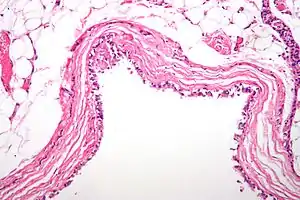 | |
| H&E stained micrograph of a mediastinal bronchogenic cyst | |
| Specialty | Pathology, general surgery |
Cancer-related cysts are formed as a defense mechanism for the body following the development of mutations that lead to an uncontrolled cellular division. Once that mutation has occurred, the affected cells divide incessantly and become cancerous, forming a tumour. The body encapsulates those cells to try to prevent them from continuing their division and contain the tumour, which becomes known as a cyst. That said, the cancerous cells still may mutate further and gain the ability to form their own blood vessels, from which they receive nourishment before being contained. Once that happens, the capsule becomes useless, and the tumour may advance from benign to cancerous.
Some cysts are neoplastic, and thus are called cystic tumors. Many types of cysts are not neoplastic; some are dysplastic or metaplastic. Pseudocysts are similar to cysts in that they have a sac filled with fluid, but lack an epithelial lining.
Terminology
- microcyst – a small cyst that requires magnification to be seen
- macrocyst – a cyst that is larger than usual or compared to others
Cysts by location
Female reproductive system
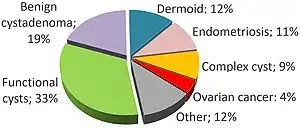
Others
- Nabothian cyst (on the surface of the cervix)
- Skene's duct cyst (lateral to urinary meatus)
- Ovarian cyst (ovary)
- Paratubal cyst (fallopian tube)
Male reproductive system
- Epididymal cyst (in the vessels attached to the testes): containing serous liquid
- Hydrocele testis (testicle): clear fluid within the cavum vaginale
- Spermatocele (testicle): clear or milky white fluid that may contain sperm
Cutaneous and subcutaneous
- Acne cyst – Pseudocysts associated with cystic acne - an inflammatory nodule with or without an associated epidermoid inclusion cyst
- Arachnoid cyst (between the surface of the brain and the cranial base or on the arachnoid membrane)
- Epidermoid cyst
- Myxoid cyst (cutaneous condition often characterized by nail plate depression and grooves)
- Pilar cyst (cyst of the scalp)
- Pilonidal cyst (skin infection near tailbone)
- Sebaceous cyst – sac below skin
- Trichilemmal cyst – same as a pilar cyst, a familial cyst of the scalp
Head and neck
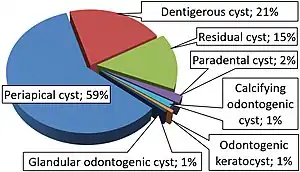
Chest
- Fibrous cyst (breast cyst)
- Pulmonary cyst (air pocket in the lung)
- Pericardial cyst (abnormal dilatation of pericardium)
Liver cysts
- Simple cysts[3]
- Hydatid cysts[3]
- Biliary cystadenoma[3]
- Biliary cystadenocarcinoma[3]
- Polycystic liver disease[3]
Others
- Adrenal cyst: Types of adrenal cysts include parasitic cysts, epithelial cysts, endothelial cysts, and pseudocysts. 56% of all adrenal cyst-like changes are pseudocysts, and only 7% of those pseudocysts are malignant or potentially malignant.[4]
- Renal cyst (kidneys)
- Pancreatic cyst[5]
- Peritoneal cyst (lining of the abdominal cavity)
Central nervous system
- Choroid plexus cyst
- Colloid cyst
- Pineal gland cyst (in the pineal gland in the brain)
- Glial cyst
- Tarlov cyst (spinal canal)
Musculoskeletal system
- Aneurysmal bone cyst, a benign bone tumor with a radiographic cystic appearance.[6]
- Baker's cyst or popliteal cyst (behind the knee joint)
- Mucoid cyst (ganglion cysts of the digits)
- Stafne static bone cyst (an anatomic variant with radiographic cystic appearance in the posterior mandible)
- Subchondral cyst (cysts near the bony joints)[7]
Seen in various locations
- Dermoid cyst (seen in ovaries, testes, and many other locations, from head to tailbone)
- Ganglion cyst (hand and foot joints and tendons)
- Mucoid cyst (ganglion cysts of the digits)
Infectious cysts
- Cysticercal cyst – an infection due to the larval stage of Taenia sp. (Crain's backs)
- Hydatid cyst – an infection in the liver or other parts of the body due to the larval stage of Echinococcus granulosus (tapeworm)
Neoplastic cysts
Treatment
Treatment ranges from simple enucleation of the cyst to curettage to resection. There are cysts—e.g., buccal bifurcation cyst—that resolve on their own, in which just close observation may be employed, unless it is infected and symptomatic.[8]
Related structures
A pseudocyst is very similar to a cyst, but is a collection of cells without a distinct membrane (epithelial or endothelial cells).
A syrinx in the spinal cord or brainstem is sometimes inaccurately referred to as a "cyst".
Cystic fibrosis
Despite being described in 1938 as "the microscopic appearance of cysts in the pancreas",[9] cystic fibrosis is an example of a genetic disorder whose name is related to fibrosis of the cystic duct (which serves the gallbladder) and does not involve cysts.[10]
This is just one example of how the Greek root cyst-, which simply means a fluid-filled sac, also is found in medical terms that relate to the urinary bladder and the gallbladder, neither of which involve cysts.
See also
References
- Abduljabbar HS, Bukhari YA, Al Hachim EG, Alshour GS, Amer AA, Shaikhoon MM, Khojah MI (July 2015). "Review of 244 cases of ovarian cysts". Saudi Medical Journal. 36 (7): 834–8. doi:10.15537/smj.2015.7.11690. PMC 4503903. PMID 26108588.
- Borges LB, Fechine FV, Mota MR, Sousa FB, Alves AP (2012). "Odontogenic lesions of the jaw: a clinical-pathological study of 461 cases". Revista Gaúcha de Odontologia. 60 (1).
- Rawla P, Sunkara T, Muralidharan P, Raj JP (March 2019). "An updated review of cystic hepatic lesions". Clinical and Experimental Hepatology. 5 (1): 22–29. doi:10.5114/ceh.2019.83153. PMC 6431089. PMID 30915403.
- Kar M, Pucci E, Brody F (October 2006). "Laparoscopic resection of an adrenal pseudocyst". Journal of Laparoendoscopic & Advanced Surgical Techniques. Part A. 16 (5): 478–81. doi:10.1089/lap.2006.16.478. PMID 17004872.
- Stark, Alexander; Donahue, Timothy R.; Reber, Howard A.; Hines, O. Joe (2016-05-03). "Pancreatic Cyst Disease: A Review". JAMA. 315 (17): 1882. doi:10.1001/jama.2016.4690. ISSN 0098-7484.
- Zadik Y, Aktaş A, Drucker S, Nitzan DW (December 2012). "Aneurysmal bone cyst of mandibular condyle: a case report and review of the literature". Journal of Cranio-Maxillo-Facial Surgery. 40 (8): e243-8. doi:10.1016/j.jcms.2011.10.026. PMID 22118925.
- Bancroft, Laura W; Peterson, Jeffrey J; Kransdorf, Mark J (January 2004). "Cysts, geodes, and erosions". Radiologic Clinics of North America. 42 (1): 73–87. doi:10.1016/S0033-8389(03)00165-9.
- Zadik Y, Yitschaky O, Neuman T, Nitzan DW (July 2011). "On the self-resolution nature of the buccal bifurcation cyst". Journal of Oral and Maxillofacial Surgery. 69 (7): e282-4. doi:10.1016/j.joms.2011.02.124. PMID 21571416.
- Andersen DH (1938). "Cystic fibrosis of the pancreas and its relation to celiac disease". American Journal of Diseases of Children. 56 (2): 344–399. doi:10.1001/archpedi.1938.01980140114013.
- Greenholz SK, Krishnadasan B, Marr C, Cannon R (February 1997). "Biliary obstruction in infants with cystic fibrosis requiring Kasai portoenterostomy". Journal of Pediatric Surgery. 32 (2): 175–9, discussion 179–80. doi:10.1016/S0022-3468(97)90174-3. PMID 9044117.
External links
| Classification |
|
|---|---|
| External resources |
- "Cyst Symptoms and Causes" by Melissa Conrad Stöppler, MD and William C. Shiel Jr., MD, FACP, FACR.
Authority control  |
|
|---|