Ioxaglic acid
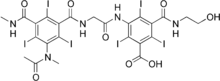
Ioxaglic acid (trade name Hexabrix) is pharmaceutical drug used as an iodinated contrast medium for X-ray imaging. It has low osmolality (relatively few molecules per volume), typically resulting in fewer side effects than high-osmolality media.[1] It is manufactured by Guerbet, but marketing in the US has been discontinued.[2] As of 2021, it may still be available in some European countries.[3]
 | |
| Clinical data | |
|---|---|
| Trade names | Hexabrix |
| AHFS/Drugs.com | FDA Professional Drug Information |
| Routes of administration | Intravascular, intraarticular, by mouth |
| ATC code | |
| Legal status | |
| Legal status |
|
| Pharmacokinetic data | |
| Metabolism | None |
| Elimination half-life | 90 min |
| Excretion | Unchanged via kidneys |
| Identifiers | |
IUPAC name
| |
| CAS Number | |
| PubChem CID | |
| DrugBank | |
| ChemSpider | |
| UNII | |
| KEGG | |
| ChEMBL | |
| CompTox Dashboard (EPA) | |
| ECHA InfoCard | 100.055.945  |
| Chemical and physical data | |
| Formula | C24H21I6N5O8 |
| Molar mass | 1268.886 g·mol−1 |
| 3D model (JSmol) | |
SMILES
| |
InChI
| |
It is applied in form of its salts, ioxaglate meglumine and ioxaglate sodium.[2]
Medical uses
Uses include angiography (imaging of blood vessels, including those of the brain and heart), arthrography (imaging of joints), urography (imaging of the urinary system), hysterosalpingography (imaging of the uterus and Fallopian tubes), imaging of the gastrointestinal tract, and endoscopic retrograde cholangiopancreatography (ERCP; imaging of the biliary and pancreatic ducts).[4]
Contraindications
Ioxaglic acid is contraindicated in people with hyperthyreosis because of the drug's iodine content. It must not be used for myelography (spinal cord imaging), for hysterosalpingography in women who are pregnant or have an acute inflammation in the pelvic region, or for arthrography if the joint is infected.[2][4]
Interactions
Iodine-131, a radioactive isotope used for thyroid imaging (scintigraphy) and therapy of thyroid cancers, can be less effective when used within two to six weeks after application of ioxaglic acid because of residual iodine in the body.[4]
Pharmacology
Chemistry and mechanism of action
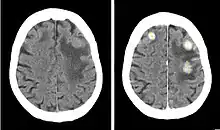
Ioxaglic acid is an iodine-containing, water-soluble radiocontrast agent. The iodine atoms readily absorb X-rays, resulting in a higher contrast of X-ray images. It has a low osmolality of 600 mosm/kg water at 37 °C (99 °F), meaning that the solution has a relatively low concentration of molecules; this is usually associated with fewer adverse effects than high-osmolality contrast agents.[2][4]
References
- Meijenhorst GC, de Bruin JN (August 1980). "Hexabrix (ioxaglate), a new low osmolality contrast agent for lumbar epidural double-catheter venography". Neuroradiology. 20 (1): 29–32. doi:10.1007/bf00346858. PMID 6999377. S2CID 39778683.
- Hexabrix FDA Professional Drug Information. Accessed 2021-03-26.
- "Ioxaglic acid: List of nationally authorised medicinal products" (PDF). European Medicines Agency. 31 October 2018.
- Haberfeld H, ed. (2020). Austria-Codex (in German). Vienna: Österreichischer Apothekerverlag. Hexabrix 320 mg Jod/ml-Ampullen.