Hydrogel dressing
Hydrogel dressings are a hydrogel pad in contact with the wound. The hydrogel is a hydrated three-dimensional (3D) network consisting of physically or chemically cross-linked bonds of hydrophilic polymers. They are designed to keep the wound moist and absorbing wound exudate.[1] Hydrogel dressing possesses a highly hydrated 3D polymeric network and can bind several-fold more water as compared to their dry weight and can thereby maintain a high level of moisture at the wound bed.[2] Furthermore, hydrogels offer a platform to load cells, antibacterial agents, growth factors, as well as distinct supplementary and biomacromolecules to accelerate the wound contraction and wound healing process.[3]
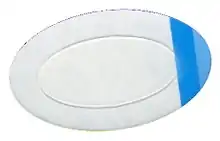
Concerning extracellular matrix similarity, hydrogels used for wound healing applications can provide a cell-friendly 3D environment to promote tissue regeneration, with or without the presence of cells embedded in the scaffold.[4][5] Importantly, all hydrogels need to satisfy the basic requirements of biocompatibility in clinical use as well as possess unique physical and mechanical properties suited for skin wound applications. Moreover, they also need to provide the appropriate microenvironment for vessel ingrowth and cellular proliferation.[6]
Polymers used in hydrogels include chitosan, dextran, kappa-carrageenan, alginate/gelatin and collagen/glycosaminoglycan. Other materials include custom polypeptides, and blends such as chitosan/sodium alginate/poly(vinyl acetate).[6][7] The physical, mechanical, and biological properties of hydrogels used as dressings can modulate by some modifications including chemical modification of polymer, crosslinking strategies, copolymerization, and nanoparticle incorporation.[6][8][9]
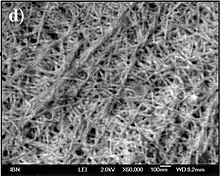
The hydrogel dressings can be prepared in the shape of the film which can directly place at the wound site. Besides, there is a new generation of hydrogel dressings that can be sprayed or injected in situ. The prepolymer solution should have shear-thinning behavior to allow spraying/injecting gel on the wound site.[6][9]
References
- Boateng JS, Matthews KH, Stevens HN, Eccleston GM (August 2008). "Wound healing dressings and drug delivery systems: a review". Journal of Pharmaceutical Sciences. 97 (8): 2892–923. doi:10.1002/jps.21210. PMID 17963217.
- Van Vlierberghe S, Dubruel P, Schacht E (May 2011). "Biopolymer-based hydrogels as scaffolds for tissue engineering applications: a review". Biomacromolecules. 12 (5): 1387–408. doi:10.1021/bm200083n. PMID 21388145.
- Gupta P, Vermani K, Garg S (May 2002). "Hydrogels: from controlled release to pH-responsive drug delivery". Drug Discovery Today. 7 (10): 569–79. doi:10.1016/S1359-6446(02)02255-9. PMID 12047857.
- Jones A, Vaughan D (2005-12-01). "Hydrogel dressings in the management of a variety of wound types: A review". Journal of Orthopaedic Nursing. 9: S1–S11. doi:10.1016/S1361-3111(05)80001-9.
- Kong X, Fu J, Shao K, Wang L, Lan X, Shi J (December 2019). "Biomimetic hydrogel for rapid and scar-free healing of skin wounds inspired by the healing process of oral mucosa". Acta Biomaterialia. 100: 255–269. doi:10.1016/j.actbio.2019.10.011. PMID 31606531.
- Tavakoli S, Klar AS (August 2020). "Advanced Hydrogels as Wound Dressings". Biomolecules. 10 (8): 1169. doi:10.3390/biom10081169. PMC 7464761. PMID 32796593.
- Seow WY, Salgado G, Lane EB, Hauser CA (September 2016). "Transparent crosslinked ultrashort peptide hydrogel dressing with high shape-fidelity accelerates healing of full-thickness excision wounds". Scientific Reports. 6: 32670. Bibcode:2016NatSR...632670S. doi:10.1038/srep32670. PMC 5013444. PMID 27600999.
- Pan Z, Ye H, Wu D (March 2021). "Recent advances on polymeric hydrogels as wound dressings". APL Bioengineering. 5 (1): 011504. doi:10.1063/5.0038364. PMC 7889296. PMID 33644627.
- Tavakoli S, Klar AS (January 2021). "Bioengineered Skin Substitutes: Advances and Future Trends". Applied Sciences. 11 (4): 1493. doi:10.3390/app11041493.