Near point
In visual perception, the near point is the closest point at which an object can be placed and still form a focused image on the retina, within the eye's accommodation range. The other limit to the eye's accommodation range is the far point.
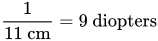
A normal eye is considered to have a near point at about 11 cm (4.3 in) for a thirty year old.[1] The near point is highly age dependent (see accommodation). A person with hyperopia or presbyopia would have a near point that is farther than normal.
Sometimes, near point is given in diopters (see Presbyopia § Mechanism), which refers to the inverse of the distance. For example a normal eye would have a near point of .
Vision correction
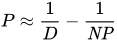
A person with hyperopia has a near point further than comfortable, (i.e. 25 cm) NP > 25 cm, and hence is unable to bring an object 25 cm away into sharp focus. A corrective lens can be used to correct hyperopia by imaging an object at distance D = 25 cm onto a virtual image at the patient's near point. From the thin lens formula, the required lens will have optical power P given by[2]
.
The calculation can be further improved by taking into account the distance between the spectacle lens and the human eye, which is usually about 1.5 cm:
.

For example, if a person has NP = 1 m, then the optical power needed is P = +3.24 diopters where one diopter is the reciprocal of one meter.
References
- Duane, Alexander (1922). "Studies in Monocular and Binocular Accommodation with their Clinical Applications". American Journal of Ophthalmology. 5 (11): 865–877. doi:10.1016/s0002-9394(22)90793-7.
- "Vision Correction | Physics". courses.lumenlearning.com. Retrieved 2019-12-05.