Rapid antigen test
A rapid antigen test (RAT), or rapid test, is a rapid diagnostic test suitable for point-of-care testing that directly detects the presence or absence of an antigen. It is commonly used for the detection of SARS-CoV-2, the virus that causes COVID-19. Rapid tests are a type of lateral flow tests that detect protein, distinguishing it from other medical tests that detect antibodies (antibody tests) or nucleic acid (nucleic acid tests), of either laboratory or point-of-care types. Rapid tests generally give a result in 5 to 30 minutes, require minimal training or infrastructure, and have significant cost advantages.
| Rapid antigen test | |
|---|---|
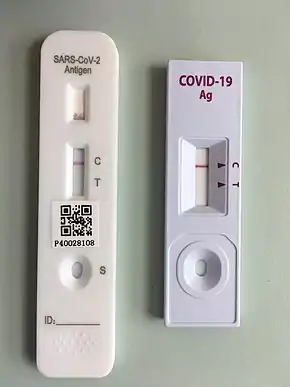 SARS-CoV-2 rapid tests. Viral antigen detection lateral flow tests | |
| Synonyms | Rapid antigen detection test (RADT), lateral flow test, lateral flow device, rapid test |
| Purpose | To diagnose infections |
Uses of Rapid Antigen tests
Common examples of RATs or RADTs include:
- COVID-19-testing-related rapid tests
- Rapid strep tests (for streptococcal antigens)[1]
- Rapid influenza diagnostic tests (RIDTs) (for influenza virus antigens)
- Malaria antigen detection tests (for Plasmodium antigens)
Scientific basis and underlying biology
Antigen tests and antibody tests are often immunoassays (IAs) of one kind or another, such as dipstick IAs or fluorescence immunoassays, however RAT is an immunochromatographic assay which gives visual results that can be seen with the naked eye. It is considered to be qualitative but a person experienced in RDT testing can easily quantify the results. Being a screening test, if the sensitivity and specificity are relatively low for the test then the results should be evaluated on the basis of confirmatory tests like PCR testing or western blot.
One inherent advantage of an antigen test over an antibody test (such as antibody-detecting rapid HIV tests) is that it can take time for the immune system to develop antibodies after infection begins, but the foreign antigen is present right away. Although any diagnostic test may have false negatives, this latency period can open an especially wide avenue for false negatives in antibody tests, although the particulars depend on which disease and which test are involved. A rapid antigen tests typically cost around US$5.00 to manufacture.
COVID-19 rapid antigen tests
Rapid antigen tests for COVID-19 are one of the most useful application of these tests. Often called lateral flow tests, they have provided global governments with several benefits. They are quick to implement with minimal training, offered significant cost advantages, costing a fraction of existing forms of PCR testing and give users a result within 5–30 minutes. Rapid antigen tests have found their best use as part of mass testing or population-wide screening approaches.[2] They are successful in these approaches because in addition to the aforementioned benefits, they identify individuals who are the most infectious and could potentially spread the virus to a large number of other people.[3] This differs slightly from other forms of COVID-19 such as PCR that are generally seen to be a useful test for individuals.
History of COVID-19 rapid test technology development
Rapid tests for COVID-19 emerged from major investment by the United Kingdom's controversial Moonshot program, a £100 billion program to systematically assess, develop and implement new technologies for COVID-19 testing.[4] Rapid tests initially sat within this systematic evaluation pipeline alongside many other putative COVID-19 testing technologies like Lamp, Lampore, point of care PCR, mass spectrometry and sample pooling. However, as evaluations continued, rapid tests emerged as the most successful form of COVID-19 testing within this program to complement existing PCR testing.
International guidance for COVID-19 rapid test technology use and development
The early scientific rationale for the potential utility of rapid tests and global direction for rapid test technology development was boosted by interim guidance from the WHO that flagged the potential benefits.[5] The report noted that rapid tests were much easier to implement, and had cost benefits. The WHO recommended their use in outbreaks, for early identification of cases and to monitor disease trends. Later, and subsequent to a rapidly increasing body of studies, this recommendation was expanded by the European Commission. The European Commission recommended the use of rapid test technology for population-wide screening where the proportion of test positivity is high or very high.[6] By January 2021, the European Commission agreed to strengthen their position, advocating much greater use of rapid tests, noting that "should research prove that rapid antigen tests can be conducted by the testee themselves.... self-testing with or without professional guidance could also be considered."[7]
Initial studies
One of the definitive studies for rapid tests was completed by Public Health England, University of Oxford and University of Manchester and launched by Professor Richard Body and Dr Lennard Lee. The Falcon-C19 study which was launched within three days on September 17th. The first patient was recruited at the Manchester City Etihad stadium carpark at a new COVID-19 testing research centre. The study rapidly extended to include 14 community research sites across the United Kingdom. The study closed on October 23rd, having completed 878 individuals. The study was one of the fastest recruiting UK COVID-19 research studies in the country. The study provided definitive evidence that rapid test devices were able to pick up positive results with high accuracy. A total of 4 rapid tests, including Innova and Orientgene were validated in this study using swab samples from individuals with symptomatic and asymptomatic disease.[8]
Around the release of the interim analysis of this UK study, the US confirmed that 100 million rapid tests would be purchased from Abbott and shipping to across the country to start similar US studies to complement the University of Oxford initiated studies.[9]
Valuation studies across the world
On 2nd of November, Slovakia became the first country in the world to initiate country-wide mass testing using rapid tests. Five million rapid tests were performed by 60,000 staff who used the SD Biosensor antigen test and performed swabbing on the population.[10][11] This then led the European Commission to recommend that Rapid tests be used as part of population-wide screening.[12] Two research studies published in early 2021, one by professor Martin Kahanec from Central European University and his coauthors and another one by Martin Pavelka from the London School of Hygiene & Tropical Medicine and his team suggest that the effects of the Autumn wave of rapid antigen mass testing in Slovakia helped to suppress the pandemic in the country, although according to the former study the effect of mass testing on the pandemic was temporary and started to dissipate after about two weeks.[13][14]
The United Kingdom continued their ongoing rapid test development program using the Innova rapid test, with increasing urgency as COVID-19 cases increased across Europe. On the 6th of November, the Prime Minister, Boris Johnson started city-wide screening of Liverpool as part of the accelerated technology evaluation.[15] Further expansion of rapid tests pilots were also launched for many sectors where testing had not been previously available. These included students at Universities who had been particularly hit by outbreaks. This initially started at Durham University who had the infrastructure and expertise to manage the Rapid test program,[16] but was expanded the majority of UK Universities and enabled the national evacuation-style plan to get students safely home for Christmas.[17] Rapid tests were also implemented within the National Health Service for staff to reduce possible transmission to patients,[18] local authorities [19][20] and Care homes to enable visits to visit residents.[21][22] On the 18th of November, Wales completed the first whole borough testing at a Merthyr Tydfil.[23][24] At this time, testing was also implemented across schools in the US for students with symptoms [25] and across Portuguese care homes and schools.[26]
Global efforts to step up evaluations of rapid tests were initiated by the World Health Organization (WHO) Emergencies Department who launched a major Rapid diagnostic test implementation project on the 10th of November, aided by agreement from the Bill and Melinda Gates Foundation that limited costs for Low and middle-income countries.[27][28]
Austria started country-wide mass testing on 5 December and ordered seven million tests consisting of the SD Biosensor test and Siemens Clinitest (aka Orientgene).[29][30]
By the middle of December, there were many studies confirming the efficacy and success of using rapid tests to identify individuals with COVID-19 including studies in the Netherlands,[31] the United Kingdom,[32] and the US.[33] These studies all enabled rapid tests to enter standard national COVID-19 testing strategies. Global piloting of rapid tests was now common place in schools in Canada,[34] travel hubs in Indonesia,[35] and across India.[36]
Concerns about use
Many individuals have raised concerns that the accuracy of rapid tests were not as good as the existing form of COVID-19 testing PCR. Data released from the United Kingdom's City-wide screen in Liverpool illustrated that army operators of the test did obtain the test performance of trained laboratory scientists,[37] following other pilots in India.[38] This caused minor issues within the scientific-psychological community where there was a debate about whether Rapid tests might lead to false reassurance and a change in behaviour. However, a shift in thinking about the use of Rapid tests was confirmed following a publication from the US. Professor Michael Mina theorised that Rapid Tests would still be useful as it identified infectious individuals,[39] and potential benefits observed from repeating rapid test and getting a result much quicker than other forms of testing.[40] The United Kingdom's chief clinical medic, Dr Susan Hopkins, also noted that Rapid tests provided a means to “test finds people that doesn't we couldn't otherwise find”.[41]
Noting the ability to identify cases more rapidly, and considering the ensuing escalation in cases in Europe, the European commission met on 11 December and developed a common European framework for “use, validation and mutual recognition of rapid tests”, committing 100 million euros for the purchase of tests from Roche and Abbott. Stella Kyriakides, commissioner for Health and Food Safety said "Rapid antigen tests offer us speed, reliability and quick responses to isolate COVID cases. This is crucial to slow down the spread of the pandemic."[42]
Other individuals have raised concerns about the slow uptake and deployment of rapid tests and potential loss of life that might have occurred as a result. An academic group from Canada noted that half the deaths in care homes in the early part of the pandemic could have been prevented with rapid tests.[43]
Global regulatory approval for use for COVID-19 testing
Following the success of numerous studies across the world to analyse rapid tests from August 2020, Rapid tests were approved by regulatory bodies across the world as part of a strategy to use testing as “a new approach to combat the pandemic”. On 16 December, the FDA became the first authority to approve the Abbott rapid test.[44] Subsequent approvals were given for the Ellume COVID-19 home test.[45]
Rapid tests were also approved by Health Canada with their advisor, Professor David Juncter noting “the best rapid tests are highly accurate at detecting contagious individuals“ and Infectious disease specialist Jean Longtin noting "It will allow us to move faster than the virus and find the person's contacts in an hour or two, instead of waiting 24 hours".[46][47]
The United Kingdom's MHRA confirmed their approval of the Innova rapid test for self-use testing on 23 December. Following the clear global success of this global development of rapid tests, Sir John Bell, Regius professor of medicine at the University of Oxford said “Rapid tests were a central bit of good defence against coronavirus because they were fast, cheap and available for repeat use”.[48]
Rapid tests as a "return to normal"
Spain became the first country to use Rapid tests to facilitate a return-to-normal with Rapid tests being widely available in pharmacies,[49] and a free music concert held in Barcelona for individuals who took a rapid test.[50] A similar approach was taken in Albania to enable music festivals.[51] However, many experts were unsure of this approach believing that “rapid tests are not the solution to restart normal life”[52] but might be used in combination with other vital infection prevention control measures such as wearing appropriate PPE, washing hands regularly and social distancing to allow people to have that vital time with those they love while helping to keep them safer.[53]
New COVID-19 strains
On 22 December 2020, a new more infectious strain of SARS-CoV-2 was identified in the United Kingdom, VOC-202012/01. The strain rapidly spread across the world. With widespread global use of this form of COVID-19 testing, there was a concern that this variant would render rapid testing obsolete. As part of the UK's accelerated technology evaluation of lateral flow, within 24 hours, Public Health England laboratories were able to confirm rapid test in global development were not affected and they could identify the new variant. This was because rapid test generally targets the nucleocapsid protein and not the spike protein.[54]
Humanitarian uses for rapid tests
In addition to routine community use, rapid tests have also been utilised as part of humanitarian efforts during the pandemic. Following the flooding in Jakarta in Indonesia on 2 December, Rapid tests were made available in flood shelters.[55] Furthermore, following the closure of national borders in Europe following the emergency of the new UK strain just before Christmas, nearly 6,000 lorry drivers were stranded without food,[56] effectively stopping Christmas food deliveries. Rapid tests were deployed by French firefighters within 24 hours at the Channel. Rapid tests enabled lorries to get on the road and complete their deliveries and return to their families for Christmas, demonstrating the potential global utility of having an easily implementable COVID-19 test.[57][58] Médecins Sans Frontières strongly endorsed the use of rapid tests in lower and middle income countries noting "COVID-19 antigen tests can deliver rapid and actionable results, ensuring timely identification of people infected with the virus at the community level".[59]
America and rapid tests
Having initially invested considerably in rapid test technology development along with the United Kingdom, further evaluation of rapid tests as part of mass testing approaches in the US stalled as a result of the impasse around the $900 billion in COVID-19 relief contained within the 2020 Consolidated Appropriations Act, 2021. The bill was criticised for not specifically ring-fencing investment in rapid tests as a cost-economical and effective form of population-wide testing.[60] Scientists in the US, such as Professor Michael Mina of Harvard University noted that tests were a “very powerful adjunct to everything else that people are already doing” and that "home tests for COVID-19 Could Slash Infection Rate".[61] This view was reinforced by Professor William A. Haseltine also of Harvard in an article in Forbes magazine proposing "rapid, self-administered testing could stem the ever-surging tide of disease and death"[62] and an article by Professor Annie Sparrow of Mount Sinai, New York proposing "Cheap Mass Testing is Vital for Pandemic Victory" in view of "the emergency of the highly contagious and fast-spreading B117 strain in the UK, and a similar strain from South Africa".[63] Nevertheless, rapid home tests for COVID-19 were publicly available to individuals in January 2020 following the earlier FDA approval.[64][65] These tests were reimbursed by US health insurance for people with covid-19 symptoms, or those who have had close contact with an infected person or with someone showing symptoms. An article in the Washington Post proposed that the maximum benefit of rapid tests in the US might not be realised until "federal government covered testing for asymptomatic people because transmission by those people is such a huge part of the outbreak" as testing these individuals was not covered by health insurance.[65] Following the election of a new president in January 2021, the US began to restart investing in rapid test technology development with the publication of presidential executive orders.[66][67]
Global market value
Following the widespread use of rapid tests across the world, rapid tests have a market value of $15 billion, however, the market is expected to cease from 2024 due to the vaccination of global population by the end of 2023.[68] In the US, the market for rapid tests was US$3.9 billion with a >20% growth rate in hospitals, clinics, Asia Pacific but also as end-user tests.[69] International market analysts have forecasted that manufacturers of rapid tests will face ongoing increasing demands as more individuals and countries start to use rapid tests to identify individuals with milder symptoms.[70] A number of commentators and scientists from the US had raised concerns whether the global manufacturing network were able to meet global demand and manufacture the hundreds of millions of tests that would be needed for frequent rapid testing.[71][72]
References
- Stewart, Emily H.; Davis, Brian; Clemans-Taylor, B. Lee; Littenberg, Benjamin; Estrada, Carlos A.; Centor, Robert M. (2014-11-04). "Rapid Antigen Group A Streptococcus Test to Diagnose Pharyngitis: A Systematic Review and Meta-Analysis". PLOS ONE. 9 (11): e111727. Bibcode:2014PLoSO...9k1727S. doi:10.1371/journal.pone.0111727. ISSN 1932-6203. PMC 4219770. PMID 25369170.
- "Press corner". European Commission - European Commission. Retrieved 2021-03-20.
- Guglielmi, Giorgia (2020-09-16). "Fast coronavirus tests: what they can and can't do". Nature. 585 (7826): 496–498. doi:10.1038/d41586-020-02661-2.
- Iacobucci, Gareth; Coombes, Rebecca (2020-09-09). "Covid-19: Government plans to spend £100bn on expanding testing to 10 million a day". BMJ. 370: m3520. doi:10.1136/bmj.m3520. ISSN 1756-1833. PMID 32907851.
- "Antigen-detection in the diagnosis of SARS-CoV-2 infection using rapid immunoassays". Word Health Organization. Retrieved 20 March 2021.
- "Coronavirus: Commission puts forward rules on rapid antigen tests and secures 20 million tests for Member States". European Council. Retrieved 20 March 2021.
- "Council agrees on strengthening the use of rapid antigen tests and on the mutual recognition of COVID-19 test results". Council of the EU. Retrieved 20 March 2021.
- "Oxford University and PHE confirm lateral flow tests show high specificity and are effective at identifying most individuals who are infectious | University of Oxford". www.ox.ac.uk. Retrieved 2020-12-27.
- "The U.S. is conducting millions more rapid coronavirus tests, but are results reported?". Global News. Retrieved 2020-12-27.
- Mahase, Elisabeth (2020-12-08). "Covid-19: Mass testing in Slovakia may have helped cut infections". BMJ. 371: m4761. doi:10.1136/bmj.m4761. ISSN 1756-1833. PMID 33293348.
- France-Presse, Agence (2020-11-02). "Slovakia carries out Covid mass testing of two-thirds of population". The Guardian. ISSN 0261-3077. Retrieved 2020-12-27.
- "Press corner". European Commission - European Commission. Retrieved 2021-03-20.
- Kahanec, Martin; Lafférs, Lukáš; Schmidpeter, Bernhard (2021-03-01). "The Impact of Mass Antigen Testing for COVID-19 on the Prevalence of the Disease". IZA Discussion Paper (14228).
- Pavelka, Martin; et al. (2021-03-23). "The impact of population-wide rapid antigen testing on SARS-CoV-2 prevalence in Slovakia". Science. doi:10.1126/science.abf9648.
- Boseley, Sarah; Elgot, Jessica (2020-11-02). "Liverpool to pioneer UK's first attempt at mass Covid testing". The Guardian. ISSN 0261-3077. Retrieved 2020-12-27.
- Sigsworth, Tim. "Covid-19 updates: University's lateral flow tests available to book from tomorrow". Palatinate. Retrieved 2020-12-27.
- "Covid-19: Universities to oversee student exodus for Christmas". BBC News. 2020-11-11. Retrieved 2020-12-27.
- Serle2020-11-09T17:19:00+00:00, Jack. "NHS staff to get twice-weekly home covid tests with immediate effect". Health Service Journal. Retrieved 2020-12-27.
- "More rapid COVID-19 tests to be rolled out across England". GOV.UK. Retrieved 2020-12-27.
- "Roll out of lateral flow tests to local authorities". GOV.UK. Retrieved 2020-12-27.
- "COVID-19: Care home residents allowed to see family after rapid tests rolled out - 'it was very emotional'". Sky News. Retrieved 2020-12-27.
- "£149 million to support increased care home testing". GOV.UK. Retrieved 2020-12-27.
- "Mass Testing in Merthyr Tydfil to continue until Friday". 2020-12-14. Retrieved 2020-12-27.
- Wightwick, Abbie (2020-12-10). "Results of mass coronavirus testing in Merthyr schools released". WalesOnline. Retrieved 2020-12-27.
- Writer, Rachel OhmStaff (2020-12-21). "Dozens of Maine schools now using COVID rapid tests for students and staff". Press Herald. Retrieved 2020-12-27.
- Donn, Natasha (2020-10-27). "Portugal rolls out 'rapid tests' to help stem outbreaks in schools and OAP homes". Portugal Resident. Retrieved 2020-12-27.
- "SARS-CoV-2 Antigen detecting rapid diagnostic test implementation projects". www.who.int. Retrieved 2020-12-27.
- "Global partnership to make available 120 million affordable, quality COVID-19 rapid tests for low- and middle-income countries". www.who.int. Retrieved 2020-12-27.
- "COVID-19 Mass Testing in Austria: All Details". Vindobona.org | Vienna International News. Retrieved 2020-12-27.
- "How mass testing is working in Austria". www.thelocal.at. Retrieved 2020-12-27.
- Gremmels, Hendrik; Winkel, Beatrice M. F.; Schuurman, Rob; Rosingh, Andert; Rigter, Nicolette A. M.; Rodriguez, Olga; Ubijaan, Johan; Wensing, Annemarie M. J.; Bonten, Marc J. M.; Hofstra, L. Marije (2020-12-05). "Real-life validation of the Panbio™ COVID-19 antigen rapid test (Abbott) in community-dwelling subjects with symptoms of potential SARS-CoV-2 infection". EClinicalMedicine. 0: 100677. doi:10.1016/j.eclinm.2020.100677. ISSN 2589-5370. PMC 7832943. PMID 33521610.
- Batra, Rahul; Olivieri, Luis Gonzalez; Rubin, Delfin; Vallari, Ana; Pearce, Sandra; Olivo, Ana; Prostko, John; Nebbia, Gaia; Douthwaite, Sam; Rodgers, Mary; Cloherty, Gavin (November 2020). "A comparative evaluation between the Abbott Panbio™ COVID-19 IgG/IgM rapid test device and Abbott Architect™ SARS CoV-2 IgG assay". Journal of Clinical Virology. 132: 104645. doi:10.1016/j.jcv.2020.104645. ISSN 1386-6532. PMC 7493757. PMID 32961429.
- Basu, Atreyee; Zinger, Tatyana; Inglima, Kenneth; Woo, Kar-mun; Atie, Onome; Yurasits, Lauren; See, Benjamin; Aguero-Rosenfeld, Maria E. (2020-07-23). "Performance of Abbott ID Now COVID-19 Rapid Nucleic Acid Amplification Test Using Nasopharyngeal Swabs Transported in Viral Transport Media and Dry Nasal Swabs in a New York City Academic Institution". Journal of Clinical Microbiology. 58 (8). doi:10.1128/JCM.01136-20. ISSN 0095-1137. PMC 7383552. PMID 32471894.
- "Rapid COVID-19 Testing Expands to Include Vulnerable Populations in Alberta". thestar.com. 2020-12-23. Retrieved 2020-12-27.
- CoconutsBali (2020-12-22). "Passengers form long queues to take antigen rapid tests in Bali's Ngurah Rai Airport | Coconuts Bali". Coconuts. Retrieved 2020-12-27.
- Pinto, Richa; Malathy Iyer (Jun 28, 2020). "Mumbai: As 15-minutes rapid tests start this week, spike in cases expected". Mumbai News. The Times of India. Retrieved 2020-12-27.
- Topping, Alexandra (2020-12-23). "Scientists in Liverpool mass Covid testing trial defend rapid tests". The Guardian. ISSN 0261-3077. Retrieved 2020-12-27.
- Saxena, Ragini (2020-08-17). "Why India's rapid antigen tests for coronavirus are like 'flipping a coin'". ThePrint. Retrieved 2020-12-27.
- Mina, Michael J.; Parker, Roy; Larremore, Daniel B. (2020-11-26). "Rethinking Covid-19 Test Sensitivity — A Strategy for Containment". New England Journal of Medicine. 383 (22): e120. doi:10.1056/NEJMp2025631. ISSN 0028-4793. PMID 32997903.
- Larremore, Daniel B.; Wilder, Bryan; Lester, Evan; Shehata, Soraya; Burke, James M.; Hay, James A.; Tambe, Milind; Mina, Michael J.; Parker, Roy (2020-11-20). "Test sensitivity is secondary to frequency and turnaround time for COVID-19 screening". Science Advances. 7 (1): eabd5393. doi:10.1126/sciadv.abd5393. ISSN 2375-2548. PMC 7775777. PMID 33219112.
- "Negative result in rapid Covid test is not green light to abandon social distancing, top medic warns". The Independent. 2020-12-05. Retrieved 2020-12-27.
- "Press corner". European Commission - European Commission. Retrieved 2020-12-27.
- "Rapid tests could have prevented half of B.C. care home deaths in 2020, modelling suggests". CTVNews. Retrieved 2021-03-20.
- Commissioner, Office of the (2020-12-17). "Coronavirus (COVID-19) Update: FDA Issues New Authorization for the BinaxNOW COVID-19 Ag Card Home Test". FDA. Retrieved 2020-12-27.
- Courage, Katherine Harmon (2020-12-18). "Rapid at-home Covid-19 tests are finally here. Here's how they could help end the pandemic". Vox. Retrieved 2020-12-27.
- "Rapid test very reliable when used on symptomatic patients, Quebec scientists find | CBC News". CBC. Retrieved 2020-12-27.
- Canada, Rapid Test & Trace (2020-12-17). "Rapid Test & Trace Canada raises awareness about the benefits of rapid testing and tracing". GlobeNewswire News Room. Retrieved 2020-12-27.
- Topping, Alexandra (2020-12-23). "Scientists in Liverpool mass Covid testing trial defend rapid tests". The Guardian. ISSN 0261-3077. Retrieved 2020-12-27.
- Glenn, Alex (2020-12-07). "Pharmacies in Spain to Roll out Rapid Tests for COVID-19". Euro Weekly News Spain. Retrieved 2020-12-27.
- Dorn, Sara (2020-12-13). "Barcelona hosts concert for 500 residents in COVID rapid-test experiment". New York Post. Retrieved 2020-12-27.
- "Albanian government has approved rapid Covid testing for Unum Festival 2021". Crack Magazine. 2020-12-02. Retrieved 2020-12-27.
- "Rapid tests are not the solution to restart normal life, expert says". The Brussels Times. 2020-12-22. Retrieved 2020-12-27.
- "Lateral flow testing – new rapid tests to detect COVID-19 - Public health matters". publichealthmatters.blog.gov.uk. Retrieved 2020-12-27.
- "Rapid evaluation confirms lateral flow devices effective in detecting new COVID-19 variant". GOV.UK. Retrieved 2020-12-27.
- Post, The Jakarta. "North Jakarta to provide rapid tests for people in flood shelters". The Jakarta Post. Retrieved 2020-12-27.
- "Covid-19: Charities send food to stranded truckers". BBC News. 2020-12-23. Retrieved 2020-12-27.
- Rawlinson, Kevin; Halliday, Josh (2020-12-24). "Army to take over Covid testing for hauliers trapped near Dover". The Guardian. ISSN 0261-3077. Retrieved 2020-12-27.
- "COVID-19: Raw anger among lorry drivers in Dover as coronavirus testing fails to ease tensions". Sky News. Retrieved 2020-12-27.
- "COVID-19 diagnostics: MSF welcomes more affordable rapid tests for lower- and middle-income countries - World". ReliefWeb. Retrieved 2021-03-20.
- Dickerson, Matthew. "9 Things You Need to Know About the $1.4 Trillion Fiscal Year 2021 Omnibus and $900 Billion COVID-19 Package". The Heritage Foundation. Retrieved 2021-03-20.
- Virginia Allen (2020-12-11). "How Rapid-Result, at-Home COVID-19 Tests Could Slash Infection Rate". The Daily Signal. Retrieved 2021-03-20.
- Haseltine, William A. "Even With A Vaccine, We Still Need Rapid Tests To End Covid-19". Forbes. Retrieved 2021-03-20.
- Sparrow, Annie. "Cheap Mass Testing Is Vital for Pandemic Victory". Foreign Policy. Retrieved 2021-03-20.
- Courage, Katherine Harmon (2020-12-18). "Rapid at-home Covid-19 tests are finally here. Here's how they could help end the pandemic". Vox. Retrieved 2021-03-20.
- https://www.washingtonpost.com/health/2020/12/16/coronavirus-home-test-rapid/
- "Combating COVID-19". The White House. Retrieved 2021-03-20.
- "Biden executive orders address COVID-19, other health care issues". Roll Call. 2021-01-21. Retrieved 2021-03-20.
- "Global COVID 19 Rapid Test Kits Market Size, Share, Trends, Strategies". www.thebusinessresearchcompany.com. Retrieved 2020-12-27.
- Data, Reports and (2020-04-28). "Rapid Test Kit Market For COVID-19 To Reach USD 3.91 Billion By 2027 | Reports and Data". GlobeNewswire News Room. Retrieved 2020-12-27.
- Company, The Business Research (2020-09-03). "COVID-19 Rapid Test Kits Manufacturing To Increase Due To Testing Of People With Mild Symptoms". GlobeNewswire News Room. Retrieved 2020-12-27.
- Rubin, Rita (2020-11-10). "The Challenges of Expanding Rapid Tests to Curb COVID-19". JAMA. 324 (18): 1813–1815. doi:10.1001/jama.2020.21106. ISSN 0098-7484. PMID 33084882.
- "Huge demand for COVID-19 rapid antigen testing may face manufacturing constraints". Modern Healthcare. 2020-10-08. Retrieved 2020-12-27.