Tooth brushing
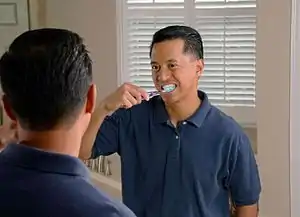
Tooth brushing is the act of scrubbing teeth with a toothbrush, usually equipped with toothpaste. Interdental cleaning (with floss or an interdental brush) can be useful with tooth brushing, and together these two activities are the primary means of cleaning teeth, one of the main aspects of oral hygiene.[1]
History
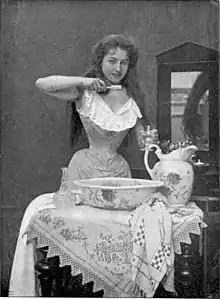
As long ago as 3000 B.C., the ancient Egyptians constructed crude toothbrushes from twigs and leaves to clean their teeth. Similarly, other cultures such as the Greeks, Romans, Arabs and Indians cleaned their teeth with twigs. Some would fray one end of the twig so that it could penetrate between the teeth more effectively.
Modern day toothbrushing as a regular habit became prevalent in Europe from the end of the 17th century. The first mass-produced toothbrush was developed in England in 1780. In the United States, although toothbrushes were available at the end of the 19th century, the practice did not become widespread until after the Second World War, when US soldiers continued the toothbrushing that had been required during their military service.[2]. The first toothbrush mass produced was actually made in England in 1780. While languishing in jail, William Addis decided to drill holes into a sheep's tibia, and pulled through the bristles of boar hair. Which he made into a toothbrush which gave him the idea to mass produce it on the outside under the name Wisdom Toothbrushes. They stayed family owned until 1996.
Reasons
Brushing teeth properly helps prevent cavities, and periodontal, or gum disease, which causes at least one-third of adult tooth loss.[3] If teeth are not brushed correctly and frequently, it could lead to the calcification of saliva minerals, forming tartar. Tartar hardens (then referred to as 'calculus') if not removed every 48 hours.[4] Poor dental health has been associated with heart disease and shortened life expectancy.[5][6][7]
Many serious problems result from not maintaining proper oral hygiene. Not brushing your teeth causes harmful bacteria to build upon your teeth and gums.[8] Bacteria growing in your mouth can infect your gums and then can travel into your blood vessels. When gingivitis and periodontitis bacteria move into your blood vessels, it can cause inflation and damaged vessels. It clogs blood vessels, making it hard for blood to flow and can lead to blood clots, heart attacks, and strokes. Although the study at Harvard Medical School has observed “remnants of oral bacteria within atherosclerotic blood vessels far from the mouth,” there are other factors including gender, alcohol consumption, diabetes, exercise, smoking, and family history of heart problems that could increase the risk of coronary artery disease as well. These factors make it hard to judge how much not brushing your teeth elevates your risk of coronary heart disease, but there is a proven correlation between poor oral health and coronary heart disease.[9][8]
Another negative side effect of not brushing your teeth is halitosis or bad breath. According to The American Dental Association, not brushing properly allows remnants of food to collect on the teeth, gum line, and the surface of the tongue. Tooth plaque leads to gingivitis and periodontitis bacteria build-up, which produces bad smelling odors. Having bad breath is very common, and most people experience it, but not brushing your teeth makes you especially prone to bad odors. The ADA states that properly brushing your teeth to remove bacteria that contribute to oral odors will improve your oral hygiene and keep your breath smelling as fresh as possible.[10][11]
Toothbrushing guidelines
Frequency
A 2008 review[12] cites studies from 1969-1973[4] that gum and tooth health were maintained if brushing removed dental plaque more often than every 48 hours, and gum inflammation happened if brushing happened at intervals longer than 48 hours. The 2008 review noted that toothbrushing can remove plaque up to one millimeter below the gum line, and that each person has a habitual brushing method, so more frequent brushing does not cover additional parts of the teeth or mouth.[12]
Dentists consider the extra abrasion of dentin from brushing multiple times per day to be insignificant,[13] since modern toothpastes have Relative Dentin Abrasivity below 250.[14]
When asked to brush "to the best of their abilities" young adults brushed longer, but did not cover any additional parts of their mouths. They brushed especially long on the grinding surfaces of back teeth (occlusal), which are the prime location for cavities in young children, but not in adults, where sides are more prone to cavities.[15]
A 2005 review of dental studies found consensus that a thorough toothbrushing once a day is sufficient for maintaining oral health, and that most dentists recommended patients brush twice a day in the hope that more frequent brushing would clean more areas of the mouth.[16]
A 2018 review noted that toothbrushing is the most common preventive healthcare activity, but tooth and gum disease remain high, since lay people clean at most 40% of their tooth margins at the gum line. Videos show that even when asked to brush their best, they do not know how to clean effectively.[15] Another 2018 study found that dental professionals did clean their teeth effectively.[17]
Contamination
A 2012 literature review found that bacteria survive on toothbrushes over 24 hours in moist conditions, less so when air-dried, though they can pick up contamination from the surrounding environment. Brushes can be decontaminated by soaking for 20 minutes in mouthwash. Harmful bacteria are present on brushes of healthy and sick people, and can add to their infectious load.[18]
Mouthwashes themselves reduce plaque by an average of 35% if they contain essential oils or chlorhexidine gluconate. The research does not report the extent of simultaneous tooth brushing by participants in mouthwash studies. Side effects of mouthwashes with essential oils and alcohol include poor taste and oral irritation. Side effects of those with chlorhexidine gluconate include tooth stains, calculus, taste disturbance and effects on the mouth lining.[19]
Proper technique
Standard advice is that the front and backs of teeth should be brushed with the toothbrush at a 45 degree angle towards the gum line, moving the brush in a back and forth rolling motion that makes contact with the gum line and tooth.[20] To brush the backs of the front teeth the brush should be held vertically to the tooth and moved in an up and down motion.[20] The chewing surfaces of the teeth are brushed with a forward and back motion, with the toothbrush pointing straight at the tooth.[20]
Specialized advice for OralB rotating electric brushes is to follow the shape of each tooth and the gums, holding the brush against each tooth surface one at a time,[21] for 1-2 seconds per tooth.[22] Advice for Sonicare is to use a slight angle, so longer bristles can reach between the teeth,[23][24] for 3-5 small circles in 1-2 seconds on each tooth.[22] Bristles conform to tooth shapes.[25]
Toothbrushing before breakfast/dinner
One study found that brushing immediately after an acidic meal (such as diet soda and common breakfast foods like orange juice, citrus fruit, dried fruit, bread, pastries[26]) caused more damage to enamel and the dentin, compared to waiting 30 minutes. Flushing the acid away with water or dissolved baking soda could help reduce acid damage exacerbated by brushing. The same response was recommended for acid re-flux and other acidic meals.[27] Researchers and dentists have concluded that brushing immediately after consuming acidic beverages should be avoided. Better to brush before breakfast or dinner.[28] If brushing after a meal, wait at least a half hour after eating to prevent damage to your teeth.[29]
When you’re looking to protect your tooth enamel, brushing right after you wake up in the morning is better than brushing your teeth after breakfast. If you have to brush your teeth after breakfast, try to wait between 30 and 60 minutes before you brush. Brushing in the morning, whenever you’re able to do it, is still better than skipping the step of brushing your teeth at all.[30]
Toothbrush
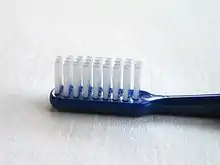
A toothbrush is an instrument used to clean teeth, consisting of a small brush on a handle. Toothpaste, often containing fluoride, is commonly added to a toothbrush to aid in cleaning. Toothbrushes come in manual and electric varieties. Although there is conflicting evidence as to which is more effective, most evidence points to electric toothbrushes with an oscillatory motion being more effective than manual toothbrushes, with toothbrushes lacking an oscillatory motion being equivalent.[31] A 2014 Cochrane review found moderate evidence that electric toothbrushing reduce plaque and gingivitis more than the manual one.[31] Overall, both manual and electric toothbrushes are effective, however, and it is often recommended that people use whichever one they feel comfortable with, determine what is affordable for them and will be more likely to regularly brush with.[32]
Toothbrushes are offered with varying textures of bristles, and come in many different forms and sizes. Most dentists recommend using a toothbrush labelled "soft", since firmer bristled toothbrushes can damage tooth enamel and irritate gums as indicated by the American Dental Association. Toothbrushes are often made from synthetic fibers, although natural toothbrushes are also known in many parts of the world. Those with dentures may also brush their teeth with traditional tooth brushes, specially made denture brushes or denture cleaners. The first mass produced toothbrush was made in England in 1780. While languishing in jail, William Addis decided to drill holes into a sheep's tibia, and pulled through the bristles of boar hair. Which he made into a toothbrush which gave him the idea to mass produce it on the outside under the name Wisdom Toothbrushes. They stayed family owned until 1996.
Toothpaste
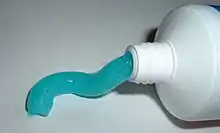
Toothpaste is a paste or gel dentifrice used to clean and improve the aesthetic appearance and health of teeth. It is almost always used in conjunction with a toothbrush. Toothpaste use can promote good oral hygiene: it can aid in the removal of dental plaque and food from the teeth, it can aid in the elimination and/or masking of halitosis when tonsil stones are not the cause, and it can deliver active ingredients such as fluoride to prevent tooth and gum (gingiva) disease.
There is evidence that the addition of xylitol to fluoride-containing toothpastes reduces incidence of tooth decay by about 13%.[33]
Tooth powder (or 'toothpaste powder') is an alternative to toothpaste. It may be recommended for people with sensitive teeth. Tooth powder typically does not contain the chemical sodium lauryl sulphate which can be a skin irritant.[34] The function of sodium lauryl sulphate is to form suds when teeth are brushed. It is a common chemical in toothpaste. Those with dentures may also use denture cleaner which can also come in powder format.
See also
References
- Worthington HV, MacDonald L, Poklepovic Pericic T, Sambunjak D, Johnson TM, Imai P, Clarkson JE (April 2019). "Home use of interdental cleaning devices, in addition to toothbrushing, for preventing and controlling periodontal diseases and dental caries". The Cochrane Database of Systematic Reviews. 4: CD012018. doi:10.1002/14651858.cd012018.pub2. PMC 6953268. PMID 30968949.
- Bellis M. "History of the Toothbrush and Toothpaste". About.com Money.
- van der Weijden F, Slot DE (Nov 2, 2012). "The effectiveness of toothbrushing". Dental Tribune.
- Brushing at least every 48 hours:
- Lang NP, Cumming BR, Löe H (July 1973). "Toothbrushing frequency as it relates to plaque development and gingival health". Journal of Periodontology. 44 (7): 396–405. doi:10.1902/jop.1973.44.7.396. hdl:2027.42/141632. PMID 4514570.
- Löe H (1967). "The Gingival Index, the Plaque Index and the Retention Index Systems". Journal of Periodontology. 38 (6): Suppl:610–6. doi:10.1902/jop.1967.38.6.610. PMID 5237684.
- Loe H (1970). "A review of the prevention and control of plaque.". In McHugh WD (ed.). Dental plaque. Edinburgh and London: E&S Livingstone. pp. 259–270.
- Li X, Kolltveit KM, Tronstad L, Olsen I (October 2000). "Systemic diseases caused by oral infection". Clinical Microbiology Reviews. 13 (4): 547–58. doi:10.1128/cmr.13.4.547-558.2000. PMC 88948. PMID 11023956.
- Lai YL (August 2004). "Osteoporosis and periodontal disease" (PDF). Journal of the Chinese Medical Association : JCMA. 67 (8): 387–8. Archived from the original (PDF) on 4 March 2016.
- Demmer RT, Desvarieux M (October 2006). "Periodontal infections and cardiovascular disease: the heart of the matter" (PDF). Journal of the American Dental Association. 137 (Suppl): 14S–20S, quiz 38S. doi:10.14219/jada.archive.2006.0402. PMID 17012731. Archived from the original (PDF) on 2012-11-18.
- Batty GD, Jung KJ, Mok Y, Lee SJ, Back JH, Lee S, Jee SH (April 2018). "Oral health and later coronary heart disease: Cohort study of one million people". European Journal of Preventive Cardiology. 25 (6): 598–605. doi:10.1177/2047487318759112. PMC 5946673. PMID 29461088.
- "Licensing". Harvard Health. Harvard Publishing Health. Retrieved 2021-03-04.
- "Bad breath - Symptoms and causes". Mayo Clinic. Retrieved 2021-03-04.
- "Home - American Dental Association". www.ada.org. Retrieved 2021-03-04.
- Claydon NC (2008). "Current concepts in toothbrushing and interdental cleaning". Periodontology 2000. 48: 10–22. doi:10.1111/j.1600-0757.2008.00273.x. PMID 18715352.
- "Toothpastes, Relative Dentin Abrasivity (RDA)". www.ada.org. Retrieved 2021-01-13.
- "Toothpaste Abrasiveness Ranked by RDA (Relative Dentin Abrasion) Value" (PDF). 2014-07-16. Retrieved 2021-01-12.
- Deinzer R, Ebel S, Blättermann H, Weik U, Margraf-Stiksrud J (October 2018). "Toothbrushing: to the best of one's abilities is possibly not good enough". BMC Oral Health. 18 (1): 167. doi:10.1186/s12903-018-0633-0. PMC 6194646. PMID 30340623.
- Attin T, Hornecker E (2005). "Tooth brushing and oral health: how frequently and when should tooth brushing be performed?". Oral Health & Preventive Dentistry. 3 (3): 135–40. PMID 16355646.
- Deinzer R, Schmidt R, Harnacke D, Meyle J, Ziebolz D, Hoffmann T, Wöstmann B (March 2018). "Finding an upper limit of what might be achievable by patients: oral cleanliness in dental professionals after self-performed manual oral hygiene". Clinical Oral Investigations. 22 (2): 839–846. doi:10.1007/s00784-017-2160-9. PMID 28676902.
- Frazelle MR, Munro CL (2012-01-24). "Toothbrush Contamination: A Review of the Literature". Nursing Research and Practice.
- Takenaka S, Ohsumi T, Noiri Y (November 2019). "Evidence-based strategy for dental biofilms: Current evidence of mouthwashes on dental biofilm and gingivitis". The Japanese Dental Science Review. 55 (1): 33–40. doi:10.1016/j.jdsr.2018.07.001. PMC 6354555. PMID 30733843.
- "Proper Brushing" (PDF). American Dental Hygienists Association. Retrieved 30 June 2015.
- "Using a Rechargeable Electric Toothbrush". Oral-B. Retrieved 2021-03-12.
- Love J. "How to brush your teeth properly". www.electricteeth.com. Retrieved 2021-03-12.
- "Proper Teeth Brushing Technique: Correcting Bad Brushing Habits". Philips. Retrieved 2021-03-12.
- "How to Brush with Philips Sonicare" (PDF).
- "Sonicare DiamondClean electric toothbrush". Philips. Retrieved 2021-03-12.
- "How to brush your teeth". Healthline.
- O'Connor A (21 May 2012). "Really? Never Brush Your Teeth Immediately After a Meal".
- O'Hehir TE (1 February 2004). "Brush before eating". RDH. Endeavor Business Media, LLC.
- "Should I brush before or after breakfast?". Delta Dental.
- "How to Brush Your Teeth Properly". Health Line.
- Yaacob M, Worthington HV, Deacon SA, Deery C, Walmsley AD, Robinson PG, Glenny AM (June 2014). "Powered versus manual toothbrushing for oral health". The Cochrane Database of Systematic Reviews (6): CD002281. doi:10.1002/14651858.CD002281.pub3. PMC 7133541. PMID 24934383.
- "Learn More About Toothbrushes". American Dental Association. Retrieved 1 July 2015.
- Riley P, Moore D, Ahmed F, Sharif MO, Worthington HV (March 2015). "Xylitol-containing products for preventing dental caries in children and adults". The Cochrane Database of Systematic Reviews (3): CD010743. doi:10.1002/14651858.CD010743.pub2. PMID 25809586.
- Herlofson BB, Barkvoll P (October 1994). "Sodium lauryl sulfate and recurrent aphthous ulcers. A preliminary study". Acta Odontologica Scandinavica. 52 (5): 257–9. doi:10.3109/00016359409029036. PMID 7825393.
Further reading
- Batty GD, Jung KJ, Mok Y, Lee SJ, Back JH, Lee S, Jee SH (April 2018). "Oral health and later coronary heart disease: Cohort study of one million people". European Journal of Preventive Cardiology. 25 (6): 598–605. doi:10.1177/2047487318759112. PMC 5946673. PMID 29461088.
- "Gum Disease and the Connection to Heart Disease."". Harvard Health. Harvard Publishing.
- "Learning". American Dental Association.
- "Bad Breath (Halitosis): Causes, Diagnosis, and Treatment". Medical News Today. MediLexicon International.
- "Bad Breath". Mayo Foundation for Medical Education and Research. Mayo Clinic. 10 March 2018.
External links
Authority control  |
|
|---|