Mucous membrane
A mucous membrane or mucosa is a membrane that lines various cavities in the body and covers the surface of internal organs. It consists of one or more layers of epithelial cells overlying a layer of loose connective tissue. It is mostly of endodermal origin and is continuous with the skin at a plethora body openings such as the eyes, ears, inside the nose, inside the mouth, lip, vagina, the urethral opening and the anus. Some mucous membranes secrete mucus, a thick protective fluid. The function of the membrane is to stop pathogens and dirt from entering the body and to prevent bodily tissues from becoming dehydrated.
| Mucous membrane | |
|---|---|
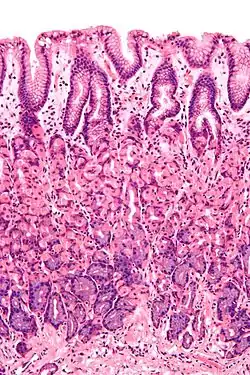 Histological section taken from the gastric antrum, showing the mucosa of the stomach | |
| Details | |
| Identifiers | |
| Latin | tunica mucosa |
| MeSH | D009092 |
| TA98 | A05.4.01.015 A05.3.01.029 A05.5.01.029 A05.6.01.009 A05.6.01.010 A05.7.01.006 A05.7.01.007 A05.8.02.009 A06.1.02.017 A06.2.09.019 A06.3.01.010 A06.4.02.029 A08.1.05.011 A08.2.01.007 A08.3.01.023 A09.1.02.013 A09.1.04.011 A09.2.03.012 A09.3.05.010 A09.3.06.004 A09.4.02.015 A09.4.02.020 A09.4.02.029 A15.3.02.083 |
| Anatomical terms of microanatomy | |
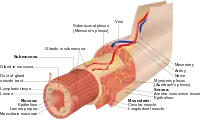 |
| This article is one of a series on the |
| Gastrointestinal wall |
|---|
Structure
The mucosa of organs are composed of one or more layers of epithelial cells that secrete mucus, and an underlying lamina propria of loose connective tissue.[1] The type of cells and type of mucus secreted vary from organ to organ and each can differ along a given tract.[2]
Mucous membranes line the digestive, respiratory and reproductive tracts and are the primary barrier between the external world and the interior of the body; in an adult human the total surface area of the mucosa is about 400 square meters while the surface area of the skin is about 2 square meters.[3]:1 They are at several places contiguous with skin: at the nostrils, the lips of the mouth, the eyelids, the ears, the genital area, and the anus.[1] Along with providing a physical barrier, they also contain key parts of the immune system and serve as the interface between the body proper and the microbiome.[2]:437
Examples
Some examples include:
- Bronchial mucosa and the lining of vocal folds
- Endometrium: the mucosa of the uterus
- Esophageal mucosa
- Gastric mucosa
- Intestinal mucosa
- Nasal mucosa
- Olfactory mucosa
- Oral mucosa
- Penile mucosa
- Vaginal mucosa
- Frenulum of tongue
- Tongue
- Anal canal
- Palpebral conjunctiva
Development
Developmentally, the majority of mucous membranes are of endodermal origin.[4] Exceptions include the palate, cheeks, floor of the mouth, gums, lips and the portion of the anal canal below the pectinate line, which are all ectodermal in origin.[5][6]
Function
One of its functions is to keep the tissue moist (for example in the respiratory tract, including the mouth and nose).[2]:480 It also plays a role in absorbing and transforming nutrients.[2]:5,813 Mucous membranes also protect the body from itself; for instance mucosa in the stomach protects it from stomach acid,[2]:384,797 and mucosa lining the bladder protects the underlying tissue from urine.[7] In the uterus, the mucous membrane is called the endometrium, and it swells each month and is then eliminated during menstruation.[2]:1019
Nutrition
Niacin[2]:876 and vitamin A are essential nutrients that help maintain mucous membranes.[8]
See also
- Alkaline mucus
- Mucin
- Mucociliary clearance
- Mucocutaneous boundary
- Mucosal immunology
- Rete pegs
References
- "Mucous membrane". Encyclopædia Britannica. Retrieved 1 August 2015.
- Guyton, Arthur C.; Hall, John E. (2005). Textbook of medical physiology (11th ed.). Philadelphia: W.B. Saunders. ISBN 0-7216-0240-1.
- Sompayrac, Lauren (2012). How the Immune System Works (4th ed.). John Wiley & Sons, Ltd. ISBN 9781118290446.
- "Chapter 25. Germ Layers and Their Derivatives - Review of Medical Embryology Book - LifeMap Discovery". discovery.lifemapsc.com. Archived from the original on 2017-01-09. Retrieved 2017-02-18.
- Squier, Christopher; Brogden, Kim (2010-12-29). "Chapter 7, Development and aging of the oral mucosa". Human Oral Mucosa: Development, Structure and Function. John Wiley & Sons. ISBN 9780470959732.
- Schoenwolf, Gary C.; Bleyl, Steven B.; Brauer, Philip R.; Francis-West, Philippa H. (2014-12-01). Larsen's Human Embryology. Elsevier Health Sciences. p. 372. ISBN 9781455727919.
- Fry, CH; Vahabi, B (October 2016). "The Role of the Mucosa in Normal and Abnormal Bladder Function". Basic & Clinical Pharmacology & Toxicology. 119 Suppl 3: 57–62. doi:10.1111/bcpt.12626. PMC 5555362. PMID 27228303.
- "Vitamin A". MedlinePlus Medical Encyclopedia. February 2, 2015. Retrieved 16 February 2017.
Authority control  |
|
|---|