Water security
Water security has been defined as "the reliable availability of an acceptable quantity and quality of water for health, livelihoods and production, coupled with an acceptable level of water-related risks".[1] It is realised to the degree that water scarcity is non-existent, or has been decreased or eliminated, and to the degree that floods and contamination of freshwater supplies are non-threatening.
"Sustainable development will not be achieved without a water secure world. A water secure world integrates a concern for the intrinsic value of water with a concern for its use for human survival and well-being. A water secure world harnesses water's productive power and minimises its destructive force. Water security also means addressing environmental protection and the negative effects of poor management. It is also concerned with ending fragmented responsibility for water and integrating water resources management across all sectors—finance, planning, agriculture, energy, tourism, industry, education and health. A water secure world reduces poverty, advances education, and increases living standards. It is a world where there is an improved quality of life for all, especially for the most vulnerable—usually women and children—who benefit most from good water governance."[2]
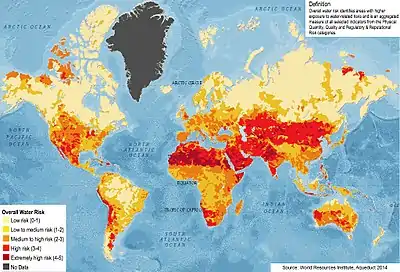
The areas of the world that are most likely to have water insecurity are places with low rainfall, places with rapid population growth in a freshwater scarce area, and areas with international competition over a water source.[3] In regions with water security issues and some water scarcity, changes in the local and global environment may soon lead to more intense regulation of water. Already in countries with high water usage, such as the United States and China, these regulations are prominent and grow in number still. International and intranational water conflicts have long been mediated by regulations and treaties, but instances involving worsening situations show some dire outlooks. [4]
Background
Water security is achieved when there is enough water for everyone in a region and the water supply is not at risk of disappearing.[3] United Nations Water considers both quantity and quality factors of accessible water when describing water security. The water should be of sufficient quantity to enable sustainable livelihood and socio-economic development, and be managed well enough to avoid water-borne pollution and disasters as well as preserve water-related ecosystems.[5] According to the Pacific Institute "While regional impacts will vary, global climate change will potentially alter agricultural productivity, freshwater availability and quality, access to vital minerals, coastal and island flooding, and more. Among the consequences of these impacts will be challenges to political relationships, realignment of energy markets and regional economies, and threats to security".[6]
It impacts regions, states and countries. Tensions exist between upstream and downstream users of water within individual jurisdictions.[7]
During history there has been much conflict over use of water from rivers such as the Tigris and Euphrates Rivers.[8] Another highly politicized example is Israel's control of water resources in the Levant region since its creation,[9] where Israel securing its water resources was one of several drivers for the 1967 Six-Day War.
The term water security encompasses ideas and concepts regarding sustainability, integration and adaptiveness of water resource management. There are four key areas of focus: increasing economic welfare, enhancing social equity, moving towards long-term sustainability and reducing water related risks.[10] Risks can be further classified as hazards (droughts, floods and quality deterioration), exposure and vulnerability.[10] Water security is sometimes sought by implementing water desalination, pipelines between sources and users, water licences with different security levels and war.
Urban water security could be understood from a systems perspective, given its complexity and cross-disciplinary nature. This involves understanding the types of pressures on the water system (such as climate change and urbanization), the state of the water system (water stocks and flows), the impact of the water system on water services provision (such as affordability and availability), and responses (including institutional reforms).[10]
Water allocation between competing users is increasingly determined by application of market-based pricing for either water licenses or actual water.[11]
Fresh water
Water, in absolute terms, is not in short supply planet-wide. But, according to the United Nations water organization, UN-Water, the total usable freshwater supply for ecosystems and humans is only about 200,000 km3 of water – less than one percent (<1%) of all freshwater resources. Usable fresh water includes water not contaminated or degraded by water-altering chemicals, such as sewage or any other harmful chemicals from continuous previous use.[12] In the 20th century, water use has been growing at more than twice the rate of the population increase. Specifically, water withdrawals are predicted to increase by 50 percent by 2025 in developing countries, and 18 per cent in developed countries.[13] One continent, for example, Africa, has been predicted to have 75 to 250 million inhabitants lacking access to fresh water.[14] By 2025, 1.8 billion people will be living in countries or regions with absolute water scarcity, and two-thirds of the world population could be under stress conditions.[15] By 2050, more than half of the world's population will live in water-stressed areas, and another billion may lack sufficient water, MIT researchers find.[16]
Threats
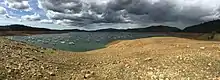
The most common threat to water security is water scarcity. There can be several causes to water scarcity including low rainfall, climate change,[17] high population density, and overallocation of a water source. About 27% of the world’s population lived in areas affected by water scarcity in the mid 2010’s. In more conservative estimates, this number is expected to increase 42% by 2050 – more dire outlooks predict an increase of 95%.[18] An example of periodic water scarcity in the United States is droughts in California. Another category of threats to water security is environmental threats.[19] These include contaminates such as biohazards (biological substances that can harm humans), climate change and natural disasters. Contaminants can enter a water source naturally through flooding. Contaminants can also be a problem if a population switches their water supply from surface water to groundwater. Natural disasters such as hurricanes, earthquakes, and wildfires can damage man-made structures such as dams and fill waterways with debris. Other threats to water security include terrorism and radiation due to a nuclear accident.[20]
Research
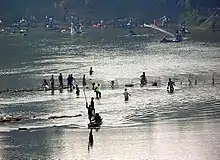
According to Nature (2010), about 80% of the world's population (5.6 billion in 2011) live in areas with threats to water security. The water security is a shared threat to human and nature and it is pandemic. Human water-management strategies can be detrimental to wildlife, such as migrating fish. Regions with intensive agriculture and dense populations, such as the US and Europe, have a high threat of water security. Water is increasingly being used as a weapon in conflict.[21] Water insecurity is always accompanied by one or more issues such as poverty, war and conflict, low women's development and environmental degradation.[22] Researchers estimate that during 2010–2015, ca US$800 billion will be required to cover the annual global investment in water infrastructure. Good management of water resources can jointly manage biodiversity protection and human water security. Preserving flood plains rather than constructing flood-control reservoirs would provide a cost-effective way to control floods while protecting the biodiversity of wildlife that occupies such areas.[23]
Lawrence Smith, the president of the population institute, asserts that although an overwhelming majority of the planet's surface is composed of water, 97% of this water is constituted of saltwater; the fresh water used to sustain humans is only 3% of the total amount of water on Earth.[24] Therefore, Smith believes that the competition for water in an overpopulated world would pose a major threat to human stability,[24] even going so far as to postulate apocalyptic world wars being fought over the control of thinning ice sheets and nearly desiccated reservoirs.[24] Nevertheless, 2 billion people have supposedly gained access to a safe water source since 1990 who may have earlier lacked it.[25] The proportion of people in developing countries with access to safe water is calculated to have improved from 30 percent in 1970.[26] to 71 percent in 1990, 79 percent in 2000 and 84 percent in 2004, parallel with rising population. This trend is projected to continue.[25]
The Earth has a limited though renewable supply of fresh water, stored in aquifers, surface waters and the atmosphere. Oceans are a good source of usable water, but the amount of energy needed to convert saline water to potable water is prohibitive with conventional approaches, explaining why only a very small fraction of the world's water supply is derived from desalination.[27] However, modern technologies, such as the Seawater Greenhouse, use solar energy to desalinate seawater for agriculture and drinking uses in an extremely cost-effective manner.
Most affected countries
_for_drinking_water_in_Soweto%252C_Johannesburg%252C_South_Africa_(2941729790).jpg.webp)
Based on the map published by the Consultative Group on International Agricultural Research (CGIAR),[28] the countries and regions suffering most water stress are North Africa, the Middle East,[29] India, Central Asia, China, Chile, Colombia, South Africa, Canada and Australia. Water scarcity is also increasing in South Asia.[30]
Israel
The Israeli Holistic Approach to Water Security draws from 70 years of experience in national security and water management. Nations such as the US, UK, Spain, and others are collaborating with Israeli experts in water security standards.[31][32]
International competition
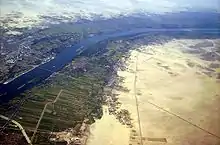
International competition over water can arise when one country starts drawing more water from a shared water source.[34] This is often the most efficient route to getting needed water, but in the long term can cause conflict if water is overdrafted.
More than 50 countries on five continents are said to be at risk of conflict over water.[35]
Turkey's Southeastern Anatolia Project (Guneydogu Anadolu Projesi, or GAP) on the Euphrates has potentially serious consequences for water supplies in Syria and Iraq.[8]
China is constructing dams on the Mekong, leaving Vietnam, Laos, Cambodia and Thailand without same amount of water as before investment.[36][37] A huge project of reversing the flow of the Brahmaputra (Chinese: Tsangpo) river, which after leaving Chinese Tibet flows through India and Bangladesh. The struggle for water in some afflicted regions has led inhabitants to hiring guards in order to protect wells. Moreover, Amu Daria River, shared by Uzbekistan, Turkmenistan, Tajikistan and Afghanistan, which has been nearly completely dried out, so much so that it has ceased to reach the Aral Sea/Lake, which is evaporating in an alarming pace. The fact that Turkmenistan retains much of the water before it flows into Uzbekistan.[38]
Conflict between Egypt and Ethiopia over the Grand Ethiopian Renaissance Dam escalated in 2020.[39][40] Egypt sees the dam as an existential threat, fearing that the dam will reduce the amount of water it receives from the Nile.[41] Both countries face the threat of water shortage, as demand for water is projected to increase with growing population, increased urbanisation and pursuit of economic growth. Tensions are made worse as a result of fundamental differences in beliefs over water rights; Egypt claims its rights to the Nile water on the basis of historical practice, whereas Ethiopia claims its rights to the water based on geography,[42] where 85% of its water comes from highland sources within its territory.[43] While the Nile Basin Initiative provides a platform to ensure sustainable management of water resources through cooperation of riparian countries,[44] the Cooperative Framework Agreement has only been ratified by six of 11 countries to date.[45]
Competition for transboundary water sources could also be worsened as a result of escalating tensions between countries, as in the case between India and Pakistan. Both countries are highly dependent on the Indus River Basin for water supply, which is governed primarily by the Indus Waters Treaty set out in 1960. In February 2019, India had threatened to cut off water supply to Pakistan, in response to the Kashmir military clash,[46] diverting water to areas like Jammu, Kashmir and Punjab instead. The construction of dams upstream would also result in flooding downstream if water was released too quickly.[47]
Intra-national competition
Australia
In Australia there is competition for the resources of the Darling River system between Queensland, New South Wales and South Australia.[48]
In Victoria, Australia a proposed pipeline from the Goulburn Valley to Melbourne has led to protests by farmers.[49]
In the Macquarie Marshes of NSW grazing and irrigation interests compete for water flowing to the marshes
The Snowy Mountains Scheme diverted water from the Snowy River to the Murray River and the Murrumbidgee River for the benefit of irrigators and electricity generation through hydro-electric power. During recent years government has taken action to increase environmental flows to the Snowy in spite of severe drought in the Murray Darling Basin. The Australian Government has implemented buy-backs of water allocations, or properties with water allocations, to endeavour to increase environmental flows.
India
In India, there is competition for water resources of all inter state rivers except the main Brahmaputra river among the riparian states of India and also with neighbouring countries which are Nepal, China, Pakistan, Bhutan, Bangladesh, etc.[50] Vast area of the Indian subcontinent is under tropical climate which is conducive for agriculture due to favourable warm and sunny conditions provided perennial water supply is available to cater to the high rate of evapotranspiration from the cultivated land. Though the overall water resources are adequate to meet all the requirements of the subcontinent, the water supply gaps due to temporal and spatial distribution of water resources among the states and countries in the subcontinent are to be bridged.
There is intense competition for the water available in the inter state rivers such as Kavery, Krishna, Godavari, Vamsadhara, Mandovi, Ravi-Beas-Sutlez, Narmada, Tapti, Mahanadi, etc. among the riparian states of India in the absence of water augmentation from the water surplus rivers such as Brahmaputra, Himalayan tributaries of Ganga and west flowing coastal rivers of western ghats. All river basins face severe water shortage even for drinking needs of people, cattle and wild life during the intense summer season when the rainfall is negligible.
Water security can be achieved along with energy security as it is going to consume electricity to link the surplus water areas with the water deficit areas by lift canals, pipe lines, etc.[51] The total water resources going waste to the sea are nearly 1200 billion cubic meters after sparing moderate environmental / salt export water requirements of all rivers.[52] Interlinking rivers of the subcontinent is possible to achieve water security in the Indian subcontinent with the active cooperation of the countries in the region.
United States domestic policy
The United States currently does not have a cohesive domestic water security policy.[53] Water security is projected to be a problem in the future since future population growth will most likely occur in areas that are currently water stressed.[3] Ensuring that the United States remains water secure will require policies that will ensure fair distribution of existing water sources, protecting water sources from becoming depleted, maintaining good wastewater disposal, and maintaining existing water infrastructure.[54][55] Currently there are no national limits for US groundwater or surface water withdrawal. If limits are imposed, the people most impacted will be the largest water withdrawers from a water source. In 2005, 31% of US water use was for irrigation, 49% was thermoelectric power, public supply 11%, public supply, industrial was 4%, aquaculture 2%, domestic 1%, and livestock less than 1%.[56]
The lack of current national water policy is effective in regions of the United States where there is a lot of water but not effective in regions of water scarcity. In the future, a national water security policy may have to be implemented to move water from regions that are water rich to regions that are water scarce. If new policies are implemented, the major stakeholders will be individual states (both water rich and water poor states), farmers, power companies, and other industries that use a substantial amount of water (such as mining and oil and gas).[53][19]
Water utility security
According to the United States Environmental Protection Agency (EPA), "Improving the security of our nation's drinking water and wastewater infrastructures has become a top priority since the events of 9/11.[57] Significant actions are underway to assess and reduce vulnerabilities to potential terrorist attacks; to plan for and practice response to emergencies and incidents; and to develop new security technologies to detect and monitor contaminants and prevent security breaches."[58]
One of the most important elements of water security is early and accurate contamination detection. The EPA has issued advisory material and guidelines for contamination warning systems to be implemented in water utilities and supplies. The security challenges that utilities frequently revolve around fast detection, accuracy, and the ability to take fast action when there is a water problem. If contamination is detected early enough, it can be prevented from reaching consumers, and emergency water supplies can be put into effect.[59]
In cases where contamination might still reach consumers, fast and efficient communication systems are necessary. All these factors also point to the need for organized and practiced emergency procedures and preparedness.
Regulation
Since 2002, under the Bioterrorism Act, a water utility supplying more than 3,300 people must take at least the following measures to ensure security of the water supply:[60][61][62]
- Conduct an assessment of the facility's vulnerabilities to vandalism, insider sabotage, or terrorist attack, and submit the report to the EPA.
- Show that the facility has an up-to-date emergency response plan, should an incident occur.
More recently, under the Drinking Water Security Act of 2009, the EPA is now required to establish risk-based performance standards for community water systems serving more than 3,300 people.[61]
Cincinnati Water Works, San Francisco, and New York City are among the major water utilities that have taken water security measures at their facilities, such as planning for contamination warning systems.[63]
Water utility security components
Security of a water supply involves a range of elements. Prevention and detection systems include some or all of the following: access to public health and customer complaint data, water quality monitoring equipment, sampling and analysis, cyber-security which includes situation management and IT systems hardware and software, and physical security. Crisis management and recovery, for when critical water events occur, includes flow control and security valves, rapid and effective communication systems, and emergency water supply equipment.
Specific technologies involved in water security are SCADA, GIS (geographic information system), online (real-time) water quality monitoring devices, contamination warning systems, intrusion detection systems (IDS), contamination detection devices, security valves, security cameras and fences, situation management/emergency management software, emergency supply tanks, manned (or human) security personnel, personal purification devices, and counter-terrorism intelligence.
China Domestic Policy
Due to continual economic growth and population size, China is one of the world’s leading water consumers. China withdraws roughly 600 billion cubic meters of water on a yearly basis. The country surpasses the United States by 120 billion cubic meters and falls short of India by 160 billion cubic meters.[64] For this reason, China’s domestic policy remains one of the most vital on a national and international scale.
Water Scarcity in China
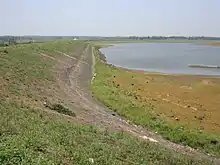
There is a large disconnect between the size of China’s population and their overall allocation of the world’s water resources, containing roughly 18% of the global population but only 6% of its water. China’s per capita water usage is just over a quarter of the global average.[65] Despite China’s immense economic growth, the World Resources Institute lists many of the more populated areas of the country as experiencing high (40% - 80% of renewable ground water extracted yearly) or extremely high (>80%) water stress. The WRI has also evaluated a similar portion of the country in the range of 3 to 5 on their overall water risk index, a measurement accounting for a variety of qualitative and quantitative evaluations.[66] Issues relating to water quality and quantity are likely primary limiting factors in China’s sustainable economic and infrastructural development.[67]
Yet, despite China’s water predicament, there has actually been a deal of progress made over the last 3 decades in providing its citizens with improved drinking water. According to the UN, almost a quarter of the world’s progress in this regard occurred in China, with 457 million citizens seeing enhanced water availability and quality from 1990 to 2010. The UN attribute this progress to increased water pipe systems, highlighting the importance of domestic policy.[68]
China's Water Security Plan
Perhaps one of the more well known initiatives of the Chinese government for the purposes of water sustainability is the South-to-North Water Diversion Project. The project is one of the largest of its kind and intends to reroute water from the less populated, high water availability areas in Southern China to the population centers with water supply issues of Northern China. The project should help to alleviate water shortages for citizens in these areas in the process of sustaining water consumption in sectors that use large sums of water, such as industry and agriculture.[69]
China introduces five year plans every fifth year pertaining to various issues facing the country. They are a guiding initiative that do not necessarily pertain to legal enforcement, but rather economic and social guidance and planning.[70] The Eleventh Five-Year Plan introduced in 2006 intended see a 30% decrease in water consumption per unit industry increase, limiting water usage while enabling economic and industrial growth. In 2016, the Thirteenth Five-Year Plan was introduced along with the goal of limiting annual water consumption per year to 670 billion cubic meters. These guidelines played an important role in China showing a reduction in water consumption for the first time in over a decade in 2014.[71]
Domestic Regulations and Policy
A number of laws have been passed in the last two decades that aimed to reduce water usage, waste, and pollution as well as increase disaster preparedness.
- Water Pollution Prevention and Control Law (Amended 2017): First passed in 1984, this amendment attempts to substantially change parameters surrounding all aspects of water security. Fully encompassing specifics for actions that constitute a violation against the law, who is subject to specific enforcements, and legal liability (including a notable increase in fines) for both the perpetrators or the agency tasked with supervision that fails to act in accordance with the laws.[72]
- Resource Tax Law (2020): A law providing local government the ability to set local tax rates on natural resource usage with the intention of enabling them to protect specific resources more effectively. The law also, for the first time, lists water as a natural resource, giving local authorities the ability to promote water preservation and limit waste.[73]
- Water Law (Amended 2002): First passed in 1988, this amendment provided sections relating to water allocation right, extraction rights, use and conservation parameters, pollution prevention, and basin management. This law could be seen as a turning point in the early 2000s for water security recognition.[74]
Support and Criticism of Chinese Water Management
Some have offered praise to China’s campaign over the last two decades to improve water quality, noting the significant effort on fronts regarding industrial and agricultural pollution limitations,[75] and improved water pipe infrastructure.[68] There has also been a great deal of focus on the exponentially higher investments and spending on water conservatory projects, a trend beginning in the early 2000s. Additionally, titling the 2011 Central Document No.1 “The Decision on Accelerating the Reform and Development of Water Conservancy” is recognized as some as having been a substantial step in committing to water security due to its place as the country’s most notable policy document for the given year.[76]
However, many have their concerns and criticisms with China’s handling of the water crisis. With notable investments into conservatory projects and recognition of the issue in early 2000s legislation, many have come to criticize China for its failure to introduce effective water resource management practices earlier than their mid-2010s onset. For nearly a decade the regulations set forth in the Water Laws regulation were not effectively enforced, so although there were effective measures drafted, the issues continued to develop.[77] Following the decision to go forth with and begin building the South-to-North Water Diversion Project in 2002, there was a great deal of pushback regarding economic justification, local community disruption and relocation, and environmental strain on southern China.[78] Regardless, upon assessment and weighing of these criticisms against the benefits of water relocation, the project’s construction continues.
Blue Peace
Blue Peace is a method which seeks to transforms trans-boundary water issues into instruments for cooperation. This unique approach to turn tensions around water into opportunities for socio-economic development was developed by Strategic Foresight Group in partnership with the Governments of Switzerland and Sweden.
"The Blue Peace is an innovative approach to engage political leaders, diplomats and populations in harnessing and managing collaborative solutions for sustainable water management."
— Foreign Minister Didier Burkhalter of Swirtzerland, speaking at the UN General Assembly
Blue Peace is part of a larger trend of viewing water as a human right rather than a market commodity.[79] When water is viewed as a human right, it empowers people in water stressed areas to manage their water sources effectively.[80] Part of having effective management of water is ensuring that all socioeconomic groups of people in a region have adequate access to water, not just certain people.
Water scarcity and water conflicts
While the demand for water grows because of the growth of global population, many places around the world are also experiencing droughts and water pollution due to climate change.[81] This could trigger intense competition for water, leading to regional instability.[81] Sometimes referred to as water conflict, regulation and disputes between water access rights most often occur in areas with low water, or worsening water situations. Approximately 60% of global river water must be shared bilaterally or multilaterally, thus, agreements are frequently implemented between all parties involved.[4]
Even when these agreements are optimized for all parties involved some countries may still have to turn to water imports as a main source of freshwater. A severe example is Pakistan, a country in frequently in conflicts over water with India, who imports 76% of their water resources – India imports 34% of theirs. A select number of rivers serve as hotspots for neighboring country water sources. The Nile River’s resources, for example, are shared by 11 countries. Situations such as these have given rise to over 3800 unilateral, bilateral, or multilateral water declarations or conventions concerning water globally, and 286 treaties. As water scarcity issues increase, these may become more common and actively sought after.[4]
India-Pakistan water conflicts
Since the two countries share much of the resources of the Indus water basin, India and Pakistan decided on a notable and influential treaty called the Indus Water Treaty (IWT). The treaty is mediated by the World Bank and regulates the water use and flow of the basin’s multiple rivers by each country. The treaty has survived three wars, but seen its share of bilateral strains.[82] Following high tensions in 2019, the Indian Prime Minister threatened to restrict water flow to Pakistan in the region – an act which Pakistan would consider an act of war.[83]
Conventional fossil or nuclear energy based desalination
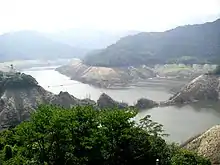
As new technological innovations continue to reduce the capital cost of desalination, more countries are building desalination plants as a small element in addressing their water crises.[84]
- Israel desalinizes water for a cost of 53 cents per cubic meter [85]
- Singapore desalinizes water for 49 cents per cubic meter [86] and also treats sewage with reverse osmosis for industrial and potable use (NEWater).
- China and India, the world's two most populous countries, are turning to desalination to provide a small part of their water needs [87][88]
- In 2007 Pakistan announced plans to use desalination [89]
- All Australian capital cities (except Darwin, Northern Territory and Hobart) are either in the process of building desalination plants, or are already using them. In late 2011, Melbourne will begin using Australia's largest desalination plant, the Wonthaggi desalination plant to raise low reservoir levels.
- In 2007 Bermuda signed a contract to purchase a desalination plant [90]
- The largest desalination plant in the United States is the one at Tampa Bay, Florida, which began desalinizing 25 million gallons (95000 m³) of water per day in December 2007.[91] In the United States, the cost of desalination is $3.06 for 1,000 gallons, or 81 cents per cubic meter.[92] In the United States, California, Arizona, Texas, and Florida use desalination for a very small part of their water supply.[93][94][95]
- After being desalinized at Jubail, Saudi Arabia, water is pumped 200 miles (320 km) inland though a pipeline to the capital city of Riyadh.[96]
A January 17, 2008, article in the Wall Street Journal states, "World-wide, 13,080 desalination plants produce more than 12 billion gallons of water a day, according to the International Desalination Association." [97]
The world's largest desalination plant is the Jebel Ali Desalination Plant (Phase 2) in the United Arab Emirates. It is a dual-purpose facility that uses multi-stage flash distillation and is capable of producing 300 million cubic meters of water per year.[98]
A typical aircraft carrier in the U.S. military uses nuclear power to desalinize 400,000 US gallons (1,500,000 L) of water per day.[99]
While desalinizing 1,000 US gallons (3,800 L) of water can cost as much as $3, the same amount of bottled water costs $7,945.[100]
However, given the energy intensive nature of desalination, with associated economic and environmental costs, desalination is generally considered a last resort after water conservation. But this is changing as prices continue to fall.
According to MSNBC, a report by Lux Research estimated that the worldwide desalinated water supply will triple between 2008 and 2020.[101]
However, not everyone is convinced that desalination is or will be economically viable or environmentally sustainable for the foreseeable future. Debbie Cook, the former mayor of Huntington Beach, California, has been a frequent critic of desalination proposals ever since she was appointed as a member of the California Desalination Task Force. Cook claims that in addition to being energy intensive, desalination schemes are very costly—often much more costly than desalination proponents claim. In her writing on the subject, Cook points to a long list of projects that have stalled or been aborted for financial or other reasons, and suggests that water-stressed regions would do better to focus on conservation or other water supply solutions than to invest in desalination plants.[102]
Food security with tiny water foot print
It is feasible to divert most of the available fresh water resources for drinking, industrial, hydro power and adequate environmental river flows purposes by reducing water use in agriculture which is consuming more than 80% of the global fresh water use. Without cultivating water intense crops, global food security can be achieved at faster pace by producing protein rich feed for cattle, poultry and fish from the cultivation of Methylococcus capsulatus bacteria culture with tiny land and water foot print using natural gas / biogas.[103][104][105][106]
See also
- Right to water
- Water scarcity
- International Water Association (IWA), a global network of 10,000 water professionals spanning the continuum between research and practice and covering all facets of the water cycle.[107]
References
- David Grey & Claudia W. Sadoff (2007-09-01). "Sink or Swim? Water security for growth and development". Water Policy. Iwaponline.com. 9 (6): 545–571. doi:10.2166/wp.2007.021. Retrieved 2014-08-16.
- "What is Water Security? - THE CHALLENGE - Global Water Partnership". Gwp.org. 2010-03-25. Retrieved 2014-08-16.
- A.A., Tindall, J.A., Campbell. "USGS Fact Sheet 2010-3106: Water Security—National and Global Issues". pubs.usgs.gov. Retrieved 2017-05-07.
- Levy, Barry S.; Sidel, Victor W. (2011). "Water Rights and Water Fights: Preventing and Resolving Conflicts Before They Boil Over". American Journal of Public Health. 101 (5): 778–780. doi:10.2105/AJPH.2010.194670. ISSN 0090-0036. PMC 3076402. PMID 21421949.
- "What is Water Security? Infographic". UN-Water. n.d. Retrieved 2021-02-11.
- Archived September 5, 2010, at the Wayback Machine
- "Retrieved 2009-01-19".
- http://www.stormingmedia.us/75/7593/A759324.html Retrieved 2009-01-19.
- Jameel M. Zayed, No Peace Without Water – The Role of Hydropolitics in the Israel-Palestine Conflict http://www.jnews.org.uk/commentary/“no-peace-without-water”-–-the-role-of-hydropolitics-in-the-israel-palestine-conflict
- Hoekstra, Arjen Y; Buurman, Joost; van Ginkel, Kees C H (2018-05-01). "Urban water security: A review". Environmental Research Letters. 13 (5): 053002. doi:10.1088/1748-9326/aaba52. ISSN 1748-9326.
- Patrick Webb and Maria Iskandarani, Water Insecurity and the Poor: Issues and Research Needs. http://www.zef.de/fileadmin/webfiles/downloads/zef_dp/zef_dp2-98.pdf, Center for Development Research, Discussion Papers on Development Policy No. 2, Bonn, October 1998.
- Viessman Jr., Warren. "Population and Water Resources". Water Encyclopedia Science and Issues. Advameg, Inc. Retrieved 6 December 2016.
- Barbier, Edward (September 25, 2015). Handbook of Water Economics. Edward Elgar Publishing. p. 550. ISBN 9781782549666. Retrieved 6 December 2016.
- "Ballooning global population adding to water crisis, warns new UN report". United Nations News Centre. UN News Centre. Retrieved 6 December 2016.
- Roberts, Alli Gold (2014-01-09). "Predicting the future of global water stress". MIT News. Retrieved 22 December 2017.
- Di Mento, John Mark (December 2006). "Beyond the water's edge: United States national security and the ocean environment". ProQuest 304741876. Cite journal requires
|journal=(help) - Boretti, Alberto; Rosa, Lorenzo (2019-07-31). "Reassessing the projections of the World Water Development Report". npj Clean Water. 2 (1): 1–6. doi:10.1038/s41545-019-0039-9. ISSN 2059-7037.
- Arnold, Craig Anthony (March 22, 2009). "Water privatization trends in the United States: human rights, national security, and public stewardship". William and Mary Environmental Law and Policy Review. 33: 785.
- "Water and Wastewater Systems Sector | Homeland Security". www.dhs.gov. Retrieved 2017-05-07.
- Report: Water and Violence Link: http://strategicforesight.com/publication_pdf/63948150123-web.pdf
- Reporter, Jumana Khamis, Staff (22 March 2015). "Refugees exacerbate water crisis in Middle East".
- Balancing water supply and wildlife Nature online 29 September 2010.
- Hoevel, Ann (April 8, 2008). "Overpopulation could be people, planet problem". CNN. Retrieved 2010-07-20.
- "The Millennium Development Goals Report, 2008" (PDF). United Nations.
- Björn Lomborg (2001). The Skeptical Environmentalist (PDF). Cambridge University Press. p. 22. ISBN 0-521-01068-3.
- World Energy Outlook 2005: Middle East and North Africa Insights. International Energy Agency, Paris. 2005.
- "Retrieved 2009-01-19".
- Jameel M. Zayed, No Peace Without Water – The Role of Hydropolitics in the Israel-Palestine Conflict http://www.jnews.org.uk/commentary/“no-peace-without-water”-–-the-role-of-hydropolitics-in-the-israel-palestine-conflict
- World Bank Climate Change Water: South Asia’s Lifeline at Risk, World Bank Washington D.C
- "Forecasthighs.com". forecasthighs.com. Retrieved 12 April 2018.
- "The Israeli Holistic Approach to Water Security". Tec Wiki. Retrieved 2014-08-16.
- "In Africa, War Over Water Looms As Ethiopia Nears Completion Of Nile River Dam". NPR. 27 February 2018.
- Grover, Velma I. (2007). Water : a source of conflict or cooperation?. Enfield, N.H.: Science Publishers.
- Forum, James Paul – Global Policy. "Water in Conflict". www.globalpolicy.org.
- "China's dams exacerbated extreme drought in lower Mekong: Study". Al Jazeera. 25 April 2020.
- "Science Shows Chinese Dams Are Devastating the Mekong". Foreign Policy. 22 April 2020.
- Prokurat, Sergiusz (2015), Drought and water shortages in Asia as a threat and economic problem (PDF), Józefów: "Journal of Modern Science” 3/26/2015, pp. 235–250, retrieved 13 August 2016
- Walsh, Decian (9 February 2020). "For Thousands of Years, Egypt Controlled the Nile. A New Dam Threatens That". New York Times. Archived from the original on 10 February 2020.
- "Are Egypt and Ethiopia heading for a water war?". The Week. 8 July 2020.
- "Row over Africa's largest dam in danger of escalating, warn scientists". Nature. 15 July 2020.
- "Nile Basin Water Wars: The Never-Ending Struggle Between Egypt, Ethiopia, and Sudan". Geopolitical Monitor. 2019-11-04. Retrieved 2020-11-20.
- Gleick, Peter; Iceland, Charles (2018). Water, Security and Conflict. Washington, DC. USA: World Resources Institute.
- User, Super. "Who we are | Nile Basin Intitative (NBI)". nilebasin.org. Retrieved 2020-11-20.
- User, Super. "CFA | Nile Basin Intitative (NBI)". nilebasin.org. Retrieved 2020-11-20.
- Dasgupta, Mehr Nadeem, Saad Sayeed, Neha (2019-08-19). "Pakistan, India spar over using water as a weapon in Kashmir dispute". Reuters. Retrieved 2020-11-20.
- "Pakistan accuses India of using water as weapon in Kashmir conflict". South China Morning Post. 2019-08-19. Retrieved 2020-11-20.
- Jackson, Sue; Head, Lesley (2020-02-01). "Australia's mass fish kills as a crisis of modern water: Understanding hydrosocial change in the Murray-Darling Basin". Geoforum. 109: 44–56. doi:10.1016/j.geoforum.2019.12.020. ISSN 0016-7185.
- "Herald Sun". Herald Sun.
- "India's water economy bracing for a turbulent future, World Bank report, 2006" (PDF). Retrieved 29 May 2015.
- Brown, Lester R. (November 29, 2013). "India's dangerous 'food bubble'". Los Angeles Times. Archived from the original on December 4, 2013. Retrieved July 13, 2014.
- IWMI Research Report 83. "Spatial variation in water supply and demand across river basins of India" (PDF). Retrieved 23 June 2015.
- Tench, Rob. "Burch, John R., Jr.: Water Rights and the Environment in the United States: A Documentary and Reference Guide." Library Journal, 15 Mar. 2016, p. 133+.
- Zhu, David Z.; Yang, Y. Jeffrey (2014). "Special Issue on Drinking Water Safety, Security, and Sustainability". Journal of Environmental Engineering. 140 (9): A2014001. doi:10.1061/(asce)ee.1943-7870.0000865.
- National Research Council (U.S.). Panel on Water System Security Research (2004). A review of the EPA water security research and technical support action plan. Washington, D.C.: National Academies Press. ISBN 978-0-309-08982-1.
- Kenny, Joan (2009). "Estimated Use of Water in the United States in 2005" (PDF). United States Geological Survey. Retrieved April 10, 2017.
- Copeland, Claudia (December 15, 2010). "Terrorism and Security Issues Facing the Water Infrastructure Sector" (PDF). Congressional Research Service. Retrieved 16 August 2014.
- Archived January 11, 2010, at the Wayback Machine
- "Water Security Initiative: Interim Guidance on Planning for Contamination Warning System Deployment" (PDF). US EPA. Retrieved 2014-08-16. Cite journal requires
|journal=(help) - "Bioterrorism Act of 2002". Fda.gov. Retrieved 2014-08-16.
- Archived July 30, 2009, at the Wayback Machine
- "IV -- Drinking Water Security and Safety". FDA. Retrieved 16 August 2014.
- staff (2009-02-23). "EPA Invests $2 Million in Philadelphia Drinking Water Security". Ens-newswire.com. Retrieved 2014-08-16.
- Ritchie, Hannah; Roser, Max (2017). "Water Use and Stress". Our World in Data. Retrieved February 28, 2021.
- Gu, Alun; Zhang, Yue; Pan, Bolin (2017). "Relationship between Industrial Water Use and Economic Growth in China: Insights from an Environmental Kuznets Curve". Water. 9 (8): 556. doi:10.3390/w9080556.
- "Aqueduct Water Risk Atlas". Aquaduct. World Resources Institute. Retrieved 2021-02-28.
- Wang, Qiang; Jiang, Rui; Li, Rongrong (2018). "Decoupling analysis of economic growth from water use in City: A case study of Beijing, Shanghai, and Guangzhou of China". Sustainable Cities and Society. 41: 86–94. doi:10.1016/j.scs.2018.05.010. ISSN 2210-6707.
- "Water for Life Decade: Asia and the Pacific". United Nations. 2014. Retrieved 2021-02-28.
- "South-to-North Water Diversion Project". Water Technology. Retrieved 2021-02-28.
- Cheng, Evelyn (2020). "China's top leaders meet this week to plan for the next five years. Here's what to expect". CNBC. Retrieved 2021-02-28.
- Zhao, Xuelian; Fan, Xinghua; Liang, Jiaochen (2017). "Kuznets type relationship between water use and economic growth in China". Journal of Cleaner Production. 168: 1091–1100. doi:10.1016/j.jclepro.2017.08.189. ISSN 0959-6526.
- "Water Pollution Prevention and Control Law of the People's Republic of China (Amended in 2017)". Ministry of Ecology and Environment: The People's Republic of China. 2017.
- Standaert, Michael (2019). "China Local Governments Gain Authority Over Resource Tax Rates". Bloomberg Law. Retrieved 2021-02-28.
- Jiang, Yong (2015). "China's water security: Current status, emerging challenges and future prospects". Environmental Science & Policy. 54: 106–125. doi:10.1016/j.envsci.2015.06.006. ISSN 1462-9011.
- Ma, Ting; Zhao, Na; Ni, Yong; Yi, Jiawei; Wilson, John P.; He, Lihuan; Du, Yunyan; Pei, Tao; Zhou, Chenghu; Song, Ci; Cheng, Weiming (2020). "China's improving inland surface water quality since 2003". Science Advances. 6 (1): eaau3798. doi:10.1126/sciadv.aau3798. ISSN 2375-2548.
- Liu, Junguo; Zang, Chuanfu; Tian, Shiying; Liu, Jianguo; Yang, Hong; Jia, Shaofeng; You, Liangzhi; Liu, Bo; Zhang, Miao (2013). "Water conservancy projects in China: Achievements, challenges and way forward". Global Environmental Change. 23 (3): 633–643. doi:10.1016/j.gloenvcha.2013.02.002. ISSN 0959-3780.
- Jiang, Yong (2015). "China's water security: Current status, emerging challenges and future prospects". Environmental Science & Policy. 54: 106–125. doi:10.1016/j.envsci.2015.06.006. ISSN 1462-9011.
- Wilson, Maxwell; Li, Xiao-Yan; Ma, Yu-Jun; Smith, Andrew; Wu, Jianguo (2017). "A review of the economic, social, and environmental impacts of China's South - North Water Transfer Project: A sustainable perspctive". Sustainability. 9: 1489. doi:10.3390/su9081489.
- Conca, K. (2008). "The United States and International Water Policy". The Journal of Environment & Development. 17 (3): 215–237. doi:10.1177/1070496508319862. S2CID 153887168.
- Figueres, Caroline (2003). Rethinking water management : innovative approaches to contemporary issues. London ; Sterling, VA: Earthscan Publications.
- "The Coming Wars for Water!". Report Syndication. October 12, 2019.
- Qamar, Muhammad Uzair; Azmat, Muhammad; Claps, Pierluigi (2019). "Pitfalls in transboundary Indus Water Treaty: a perspective to prevent unattended threats to the global security". npj Clean Water. 2 (1): 1–9. doi:10.1038/s41545-019-0046-x. ISSN 2059-7037.
- Nadeen, Mehr; Sayeed, Saad; Dasgupta, Neha (2019-08-19). "Pakistan, India spar over using water as a weapon in Kashmir dispute". Reuters. Retrieved 2021-03-26.
- "The Changing Image Of Desalination". Archived from the original on October 7, 2007. Retrieved November 21, 2012.
- "EJP | News | France | French-run water plant launched in Israel". Ejpress.org. 2005-12-28. Retrieved 2010-08-13.
- "Black & Veatch-Designed Desalination Plant Wins Global Water Distinction". Edie.net. 2006-05-04. Retrieved 2010-08-13.
- "Drought hopes hinge on desalination - World - NZ Herald News". Nzherald.co.nz. 2006-11-01. Retrieved 2010-08-13.
- "Tamil Nadu / Chennai News : Two sites for desalination plant identified". The Hindu. Chennai, India. 2007-01-17. Retrieved 2010-08-13.
- "Pakistan embarks on nuclear desalination". Archived from the original on December 16, 2008. Retrieved November 21, 2012.
- "Bermuda signs contract for seawater desalination plant". Caribbean Net News. 2007-01-20. Retrieved 2010-08-13.
- Applause, At Last, For Desalination Plant, The Tampa Tribune, December 22, 2007.
- Desalination gets a serious look, Las Vegas Sun, March 21, 2008.
- "Carlsbad Desalination Project". Carlsbaddesal.com. 2006-07-27. Retrieved 2011-03-10.
- RANDAL C. ARCHIBOLD; KIRK JOHNSON & Randal C. Archibold (2007-04-04). "No Longer Waiting for Rain, an Arid West Takes Action". reported from Yuma, Ariz., and Kirk Johnson from Denver. Western States (US); Utah; Arizona; California; Colorado; Nevada; New Mexico; Wyoming; Montana; Colorado River; Las Vegas (Nev); Yuma (Ariz): Select.nytimes.com. Retrieved 2011-03-10.
- "Technology news and new technology highlights from New Scientist - New Scientist Tech - New Scientist". New Scientist Tech. Retrieved 2010-08-13.
- Desalination is the Solution to Water Shortages, redOrbit, May 2, 2008.
- Water, Water, Everywhere..., The Wall. St Journal, January 17, 2008.
- "100 Largest Desalination Plants Planned, in Construction, or in Operation—January 1, 2005" (PDF). Retrieved 2011-03-10.
- Harris, Tom (2002-08-29). "How Aircraft Carriers Work". Science.howstuffworks.com. Retrieved 2011-03-10.
- The Arid West—Where Water Is Scarce - Desalination—a Growing Watersupply Source, Library Index
- A Rising Tide for New Desalinated Water Technologies, MSNBC, March. 17, 2009.
- Desalination: Unlocking Lessons from Yesterday’s Solution (part 1), Water Matters, January 17, 2009.
- "Food made from natural gas will soon feed farm animals – and us". Retrieved 31 January 2018.
- "Assessment of environmental impact of FeedKind protein" (PDF). Retrieved 20 June 2017.
- "BioProtein Production" (PDF). Retrieved 31 January 2018.
- "New venture selects Cargill's Tennessee site to produce Calysta FeedKind® Protein". Retrieved 31 January 2018.
- "IWA". Iwahq.org. Retrieved 2014-08-16.

Further reading
- International Water Security: Domestic Threats and Opportunities, 2008, ISBN 978-92-808-1150-6, 328 pages, Paperback by United Nations University
- Jameel M. Zayed. "No Peace Without Water – The Role of Hydropolitics in the Israel-Palestine Conflict". London.
- Rahaman, M. M. (Editor) Special Issue: Water Wars in 21st Century along International Rivers Basins: Speculation or Reality?, International Journal of Sustainable Society, Vol. 4, Nos. 1/2, 193 pages. 2012
- An open source Elsevier journal titled Water Security started publication in August 2017. Water Security
External links
- Water Security journal
- Water Quality and Security Blog
- World Water Council
- Water for Food, Water for Life: A Comprehensive Assessment of Water Management in Agriculture
- Water Conflict Chronology from "The World's Water" (Island Press, Washington) Edited by Peter Gleick
- Whitewater Security
- Asia's Next Challenge: Securing the Region's Water Future
- Water Diplomacy, Strategic Foresight Group
- Article Collection: Water Security in a Changing World, International Relations and Security Network
- US Environmental Protection Agency (EPA), Water Security Department
- World Environment Federation, "The Water Quality People"