Abamectin
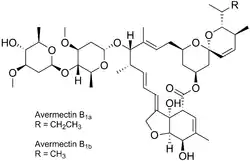
Abamectin is a widely used insecticide and anthelmintic. Abamectin, is a member of the Avermectin family and is a natural fermentation product of soil dwelling[1] actinomycete Streptomyces avermitilis [2]. Abamectin (also called Avermectin B1), differs from Ivermectin, the popular member of the Avermectin family, by double bond on C-22-25[2]. Fermentation of Streptomyces avermitilis yields 8 closely related Avermectin homologues out of which B1 (a and b) forms the bulk of the fermentation[3]. The non proprietary name, abamectin, is a combination of Bla (~ 80%) and B1b (~ 20%)[3]. Out of all the Avermectins, abamectin is the only one that is used both in agriculture and pharmaceuticals[4].
 | |
| Clinical data | |
|---|---|
| Other names | avermectin B1 (CAS name), MK-936 |
| ATCvet code |
|
| Identifiers | |
IUPAC name
| |
| CAS Number | |
| ChemSpider | |
| UNII | |
| KEGG | |
| ChEMBL | |
| CompTox Dashboard (EPA) | |
| ECHA InfoCard | 100.113.437  |
| Chemical and physical data | |
| Formula | C48H72O14 (B1a) C47H70O14 (B1b) |
| 3D model (JSmol) | |
SMILES
| |
InChI
| |
  (what is this?) (verify) (what is this?) (verify) | |
Mode of Action
Avermectins bind to the glutamate-gated chloride channels that are found in invertebrate nerve and muscle cells[5]. They cause hyperpolarization of these cells resulting in paralysis and death[5]. Mammals only possess glutamate-gated chloride channels in the brain and spinal cord and as the Avermectins have a low affinity for other mammalian ligand-gated channels and do not usually cross the blood–brain barrier, they are very safe for mammals[6].
History
Avermectins were discovered in 1967 in fermentation broths of an actinomycete culture received from the Kitasato Institute in Japan, following an intensive search designed to find natural products with anthelmintic activity[7]. It was not until 1985 ivermectin was first used to treat Onchocerca volvulus (Onchocerciasis or River blindness) in humans by united nations[8]. Discoverers of Avermectin, William C. Campbell and Satoshi Ōmura, shared the 2015 Nobel prize for physiology or medicine[9].
Activity
Abamectin is an insecticide as well as an acaricide (miticide)[2] and a nematicide. It is also used to control fire ants[10]. Abamectin is provided orally to horses for deworming them[11].
Use
Abamectin is also used as a veterinary antihelmintic. Resistance to abamectin-based antihelmintics, although a growing problem, is not as common as to other classes of veterinary antihelmintics. The benzoate salt emamectin benzoate is also used as an insecticide. Avermectins have been used to treat various ailments caused by parasites in both humans and animals[12]. Avermectins including abamectin were studied for use as anti alcohol therapies[13][12]. Recently, ivermectin is being studied for use as an anti inflammatory agent[14].
Environmental Fate
Abamectin degrades rapidly when exposed to light (photodegradation) on plant surfaces, in soil, dung and water[15]. Half life of Avermectins (including abamectin) varies between 0.5 to 23 days depending on the rate and substrate (water, soil, faeces or plant)[16]. Avermectin B1a applied at 0.02-0.03 lb ai/acre (50% higher than recommended rates) resulted in very low residue[17].
Trade names
Trade names include Abba, Abathor, Affirm, Agri-Mek, Avid, Dynamec, Epi-Mek, Genesis Horse Wormer, Reaper, Termictine 5%, Vertimec, CAM-MEK 1.8% EC (cam for agrochemicals), Zephyr and Cure 1.8 EC.
References
- Ikeda H, Ishikawa J, Hanamoto A, Shinose M, Kikuchi H, Shiba T, et al. (May 2003). "Complete genome sequence and comparative analysis of the industrial microorganism Streptomyces avermitilis". Nature Biotechnology. 21 (5): 526–31. doi:10.1038/nbt820. PMID 12692562.
- Campbell WC (6 December 2012). Ivermectin and Abamectin. Springer Science & Business Media. pp. 304–. ISBN 978-1-4612-3626-9.
- Jansson, R. K.; Dybas, R. A. (1998), Ishaaya, Isaac; Degheele, Danny (eds.), "Avermectins: Biochemical Mode of Action, Biological Activity and Agricultural Importance", Insecticides with Novel Modes of Action: Mechanisms and Application, Applied Agriculture, Berlin, Heidelberg: Springer, pp. 152–170, doi:10.1007/978-3-662-03565-8_9, ISBN 978-3-662-03565-8, retrieved 2021-04-08
- Shoop, Wesley L.; Mrozik, Helmut; Fisher, Michael H. (1995). "Structure and activity of avermectins and milbemycins in animal health". Veterinary Parasitology. 59 (2): 139–156. doi:10.1016/0304-4017(94)00743-V.
- Wolstenholme, A. J.; Rogers, A. T. (2006-03-29). "Glutamate-gated chloride channels and the mode of action of the avermectin/milbemycin anthelmintics". Parasitology. 131 (S1): S85. doi:10.1017/S0031182005008218. ISSN 0031-1820.
- Ōmura, Satoshi; Crump, Andy (2014). "Ivermectin: panacea for resource-poor communities?". Trends in Parasitology. 30 (9): 445–455. doi:10.1016/j.pt.2014.07.005.
- Lasota, J A; Dybas, R A (1991). "Avermectins, A Novel Class of Compounds: Implications for Use in Arthropod Pest Control". Annual Review of Entomology. 36 (1): 91–117. doi:10.1146/annurev.en.36.010191.000515. ISSN 0066-4170.
- CRUMP, Andy; OMURA, Satoshi (2011). "Ivermectin, 'Wonder drug' from Japan: the human use perspective". Proceedings of the Japan Academy, Series B. 87 (2): 13–28. doi:10.2183/pjab.87.13. ISSN 0386-2208.
- "The Nobel Prize in Physiology or Medicine 2015". NobelPrize.org. Retrieved 2021-04-09.
- "Ascend™ / Advance™ | Texas Imported Fire Ant Research and Management Project". fireant.tamu.edu. Retrieved 2021-04-08.
- "Equine Megastore - Horse Wormers". www.equine-mega-store.com. Retrieved 2021-04-08.
- El-Saber Batiha, Gaber; Alqahtani, Ali; Ilesanmi, Omotayo B.; Saati, Abdullah A.; El-Mleeh, Amany; Hetta, Helal F.; Magdy Beshbishy, Amany (2020). "Avermectin Derivatives, Pharmacokinetics, Therapeutic and Toxic Dosages, Mechanism of Action, and Their Biological Effects". Pharmaceuticals. 13 (8): 196. doi:10.3390/ph13080196. ISSN 1424-8247. PMC 7464486. PMID 32824399.CS1 maint: PMC format (link)
- Yardley, Megan M.; Neely, Michael; Huynh, Nhat; Asatryan, Liana; Louie, Stan G.; Alkana, Ronald L.; Davies, Daryl L. (2014-09-10). "Multiday administration of ivermectin is effective in reducing alcohol intake in mice at doses shown to be safe in humans". NeuroReport. 25 (13): 1018–1023. doi:10.1097/wnr.0000000000000211. ISSN 0959-4965.
- Ventre, E.; Rozières, A.; Lenief, V.; Albert, F.; Rossio, P.; Laoubi, L.; Dombrowicz, D.; Staels, B.; Ulmann, L.; Julia, V.; Vial, E. (2017-02-06). "Topical ivermectin improves allergic skin inflammation". Allergy. 72 (8): 1212–1221. doi:10.1111/all.13118. ISSN 0105-4538.
- Halley, Bruce A.; VandenHeuvel, William J.A.; Wislocki, Peter G. (1993). "Environmental effects of the usage of avermectins in livestock". Veterinary Parasitology. 48 (1–4): 109–125. doi:10.1016/0304-4017(93)90149-H.
- Bai, Shahla Hosseini; Ogbourne, Steven (2016). "Eco-toxicological effects of the avermectin family with a focus on abamectin and ivermectin". Chemosphere. 154: 204–214. doi:10.1016/j.chemosphere.2016.03.113. ISSN 0045-6535.
- Moye, H. Anson; Malagodi, Marjorie H.; Yoh, Jau; Leibee, Gary L.; Ku, Chia C.; Wislocki, Peter G. (1987). "Residues of avermectin B1a in rotational crops and soils following soil treatment with [14C]avermectin B1a". Journal of Agricultural and Food Chemistry. 35 (6): 859–864. doi:10.1021/jf00078a003. ISSN 0021-8561.
Further reading
- "Pesticide Information Profile: Abamectin". Pesticide Management Education Program. Extension Toxicology Network (EXTOXNET). June 1996. Archived from the original on 21 February 2021.
- "Learn more about abamectin". Crop Protection Database. Farm Chemicals International.
| Authority control |
|
|---|