Comovirinae
Comovirinae is a subfamily of viruses in the order Picornavirales, in the family Secoviridae; its genera were formerly classified in the family Comoviridae. Plants serve as natural hosts. There are currently 62 species in this subfamily, divided among 3 genera.[1][2]
| Comovirinae | |
|---|---|
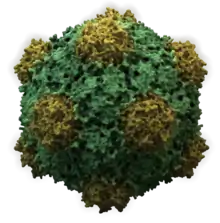 | |
| Structure of the Cowpea Mosaic Virus based on PDB 2BFU | |
Virus classification  | |
| (unranked): | Virus |
| Realm: | Riboviria |
| Kingdom: | Orthornavirae |
| Phylum: | Pisuviricota |
| Class: | Pisoniviricetes |
| Order: | Picornavirales |
| Family: | Secoviridae |
| Subfamily: | Comovirinae |
| Genera | |
Taxonomy
The genera Comovirus, Nepovirus and Fabavirus were classified into the family Comoviridae in 1993. This family was classified as part of the order Picornavirales when this order was created (2008), and its genera were reclassified as the subfamily Comovirinae of the family Secoviridae in 2009.[3][4]
Group: ssRNA(+)
- Family: Secoviridae
- Sub-Family: Comovirinae
- Genus: Comovirus
- Andean potato mottle virus
- Bean pod mottle virus
- Bean rugose mosaic virus
- Broad bean stain virus
- Broad bean true mosaic virus
- Cowpea mosaic virus
- Cowpea severe mosaic virus
- Glycine mosaic virus
- Pea green mottle virus
- Pea mild mosaic virus
- Quail pea mosaic virus
- Radish mosaic virus
- Red clover mottle virus
- Squash mosaic virus
- Ullucus virus C
- Genus: Fabavirus
- Broad bean wilt virus 1
- Broad bean wilt virus 2
- Cucurbit mild mosaic virus
- Gentian mosaic virus
- Grapevine fabavirus
- Lamium mild mosaic virus
- Prunus virus F
- Genus: Nepovirus
- Aeonium ringspot virus
- Apricot latent ringspot virus
- Arabis mosaic virus
- Arracacha virus A
- Artichoke Aegean ringspot virus
- Artichoke Italian latent virus
- Artichoke yellow ringspot virus
- Beet ringspot virus
- Blackcurrant reversion virus
- Blueberry latent spherical virus
- Blueberry leaf mottle virus
- Cassava American latent virus
- Cassava green mottle virus
- Cherry leaf roll virus
- Chicory yellow mottle virus
- Cocoa necrosis virus
- Crimson clover latent virus
- Cycas necrotic stunt virus
- Grapevine Anatolian ringspot virus
- Grapevine Bulgarian latent virus
- Grapevine chrome mosaic virus
- Grapevine deformation virus
- Grapevine fanleaf virus
- Grapevine Tunisian ringspot virus
- Hibiscus latent ringspot virus
- Lucerne Australian latent virus
- Melon mild mottle virus
- Mulberry mosaic leaf roll associated virus
- Mulberry ringspot virus
- Myrobalan latent ringspot virus
- Olive latent ringspot virus
- Peach rosette mosaic virus
- Potato black ringspot virus
- Potato virus B
- Potato virus U
- Raspberry ringspot virus
- Soybean latent spherical virus
- Tobacco ringspot virus
- Tomato black ring virus
- Tomato ringspot virus
Structure
Viruses in Comovirinae are non-enveloped, with icosahedral geometries, and T=pseudo3 symmetry. The diameter is around 30 nm. Genome segments are encapsidated separately into two different types of particle similar in sizenm. Genomes are linear and segmented, bipartite, around 24-7kb in length.[1]
| Genus | Structure | Symmetry | Capsid | Genomic arrangement | Genomic segmentation |
|---|---|---|---|---|---|
| Comovirus | Icosahedral | Pseudo T=3 | Non-enveloped | Linear | Segmented |
| Nepovirus | Icosahedral | Pseudo T=3 | Non-enveloped | Linear | Segmented |
| Fabavirus | Icosahedral | Pseudo T=3 | Non-enveloped | Linear | Segmented |
Life cycle
Viral replication is cytoplasmic. Entry into the host cell is achieved by penetration into the host cell. Replication follows the positive stranded RNA virus replication model. Positive stranded rna virus transcription is the method of transcription. The virus exits the host cell by tubule-guided viral movement. Plants serve as the natural host. Transmission routes are mechanical.[1]
| Genus | Host details | Tissue tropism | Entry details | Release details | Replication site | Assembly site | Transmission |
|---|---|---|---|---|---|---|---|
| Comovirus | Plants | None | Viral movement; mechanical inoculation | Viral movement | Cytoplasm | Cytoplasm | Mechanical inoculation: beetles |
| Nepovirus | Plants | None | Viral movement; mechanical inoculation | Viral movement | Cytoplasm | Cytoplasm | Nematodes; mites; thrips |
| Fabavirus | Plants | None | Viral movement; mechanical inoculation | Viral movement | Cytoplasm | Cytoplasm | Mechanical inoculation: aphids |
References
- "Viral Zone". ExPASy. Retrieved 15 June 2015.
- ICTV. "Virus Taxonomy: 2014 Release". Retrieved 15 June 2015.
- ICTV Taxonomy History for Comoviridae, accessed on line Nov. 20, 2015.
- ICTV Taxonomy History for Comovirinae, accessed on line Nov. 20, 2015.