Marnaviridae
Marnaviridae is a family of positive-stranded RNA viruses in the order Picornavirales.[2] The first species of this family that was isolated, and which is the type species for the family, is Heterosigma akashiwo RNA virus (HaRNAV) in the genus Marnavirus,[3] that infects the toxic bloom-forming Raphidophyte alga, Heterosigma akashiwo.[4] Using a sequence-based framework an additional twenty marine RNA viruses have been added to the family, including the following six genera: Labyrnavirus (one species), Bacillarnavirus (three species), Locarnavirus (four species), Kusarnavirus (one species), Salisharnavirus (four species) and Sogarnavirus (six species).[5]
| Marnaviridae | |
|---|---|
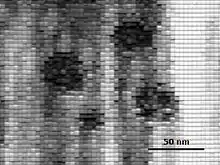 | |
| Low-resolution image of a Marnavirus under electron microscope | |
Virus classification  | |
| (unranked): | Virus |
| Realm: | Riboviria |
| Kingdom: | Orthornavirae |
| Phylum: | Pisuviricota |
| Class: | Pisoniviricetes |
| Order: | Picornavirales |
| Family: | Marnaviridae |
| Genera[1] | |
| |
HaRNAV was isolated from water collected in the Strait of Georgia in British Columbia, Canada, from a concentrated virus assemblage using the host Heterosigma akashiwo (NEPCC 522).[6] It must not be confused with other viruses infecting this host, such as Heterosigma akashiwo virus 01 (HaV-1, isolate: HaV53) of genus Raphidovirus, or Heterosigma akashiwo Nuclear Inclusion Virus (HaNIV).[7]
Structure
.png.webp)

Modified after ViralZone.[8]
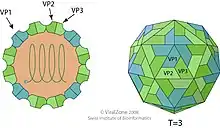
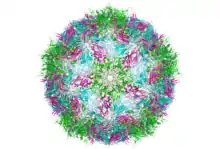
Virions in Marnaviridae are non-enveloped, with icosahedral geometries, and T=pseudo3 symmetry. The diameter is around 25 nm. Genomes are linear and non-segmented (monopartit), around 8.6 kb in length.[8] The capsid consists of three major capsid proteins (MCPs: VP1, VP2, VP3), each having a Jelly roll fold and a minor capsid protein (mCP) that is located around the five-fold axes on the inside of the capsid. [9]
| Genus | Structure | Symmetry | Capsid | Genomic arrangement | Genomic segmentation |
|---|---|---|---|---|---|
| Marnavirus | Icosahedral | Pseudo T=3 | Non-enveloped | Linear | Monopartite |
Life cycle
Entry into the host cell is achieved by penetration into the host cell. Replication follows the positive stranded RNA virus replication model. Positive stranded RNA virus transcription is the method of transcription. The virus exits the host cell by tubule-guided viral movement.[8]
Marine phytoplankton serve as the natural hosts of the only known member of the family Marnaviridae.[8]
| Genus | Host details | Tissue tropism | Entry details | Release details | Replication site | Assembly site | Transmission | |
|---|---|---|---|---|---|---|---|---|
| Marnavirus | Microphyte | Phytoplankton | None | Cell receptor endocytosis | Unknown | Cytoplasm | Cytoplasm | Passive diffusion |
References
- "Virus Taxonomy: 2018b Release". International Committee on Taxonomy of Viruses (ICTV). March 2019. Retrieved 16 March 2019.
- "Marnaviridae - Positive Sense RNA Viruses - Positive Sense RNA Viruses (2011) - International Committee on Taxonomy of Viruses (ICTV)". International Committee on Taxonomy of Viruses (ICTV). Retrieved 27 April 2017.
- ICTV. "Virus Taxonomy: 2014 Release". Retrieved 15 June 2015.
- Lang, A. S.; Culley, A. I.; Suttle, C. A. (2004). "Genome sequence and characterization of a virus (HaRNAV) related to picorna-like viruses that infects the marine toxic bloom-forming alga Heterosigma akashiwo". Virology. 320 (2): 206–217. doi:10.1016/j.virol.2003.10.015. PMID 15016544.
- Vlok, M.; Lang, A. S.; Suttle, C. A. (2019). "Application of a sequence-based taxonomic classification method to uncultured and unclassified marine single-stranded RNA viruses in the order Picornavirales". Virus Evolution. 31, 5(2):vez056. doi:10.1093/ve/vez056. PMID 31908848.
- Tai, Vera; Lawrence, Janice E.; Lang, Andrew S.; Chan, Amy M.; Culley, Alexander I.; Suttle, Curtis A. (2003). "Characterization of HaRNAV, a single-stranded RNA virus causing lysis of Heterosigma akashiwo (Raphidophyceae)". Journal of Phycology. 39 (2): 206–217. doi:10.1046/j.1529-8817.2003.01162.x.
- Lawrence, Janice E; Chan, Amy M; Suttle, Curtis A (2001). "A novel virus (HaNIV) causes lysis of the toxic bloom-forming alga Heterosigma akashiwo (Raphidophyceae)". Journal of Phycology. 37 (2): 216–222. doi:10.1046/j.1529-8817.2001.037002216.x.
- "Viral Zone". ExPASy. Retrieved 15 June 2015.
- Munke, Anna; Kimura, Kei; Tomaru, Yuji; Okamoto, Kenta (16 April 2020). "Capsid Structure of a Marine Algal Virus of the Order". Journal of Virology. 94 (9). doi:10.1128/JVI.01855-19.
External links
- Viralzone: Marnaviridae
- ICTV
- NCBI: Marnaviridae (family)
- ICTV: Taxonomy History – Marnaviridae