Ibogamine
Ibogamine is an anti-convulsant, anti-addictive CNS stimulant alkaloid found in Tabernanthe iboga and Crepe Jasmine (Tabernaemontana divaricata).[1][2][3] Basic research related to how addiction affects the brain has used this chemical.[4]
 | |
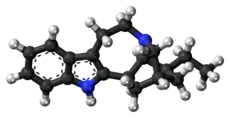 | |
| Clinical data | |
|---|---|
| ATC code |
|
| Identifiers | |
IUPAC name
| |
| CAS Number | |
| PubChem CID | |
| ChemSpider | |
| ChEBI | |
| CompTox Dashboard (EPA) | |
| Chemical and physical data | |
| Formula | C19H24N2 |
| Molar mass | 280.415 g·mol−1 |
| 3D model (JSmol) | |
SMILES
| |
InChI
| |
  (what is this?) (verify) (what is this?) (verify) | |

Ibogamine persistently reduced the self-administration of cocaine and morphine in rats.[5] The same study found that ibogamine (40 mg/kg) and coronaridine (40 mg/kg) did not produce "any tremor effects in rats that differ significantly from saline control". While the related alkaloids ibogaine (20–40 mg/kg), harmaline (10–40 mg/kg) and desethylcoronaridine (10–40 mg/kg) were "obviously tremorgenic".[5]
Pharmacology
Like ibogaine, it has seems to have similar pharmacology. It has effects on KOR[6], NMDAR, nAChR[7] and serotonin sites.[8] It also inhibits acetycholinestearase and butrylcholinestearase[9]
See also
- Coronaridine
- Ibogaine
- Ibogaline
- Tabernanthine
- Voacangine
- Harmaline
References
- Bartlett, M. F.; Dickel, D. F.; Taylor, W. I. (1958). "The Alkaloids of Tabernanthe iboga. Part IV.1 The Structures of Ibogamine, Ibogaine, Tabernanthine and Voacangine". Journal of the American Chemical Society. 80 (1): 126–136. doi:10.1021/ja01534a036.
- Kuehne, Martin E.; Reider, Paul J. (1985). "A synthesis of ibogamine". The Journal of Organic Chemistry. 50 (9): 1464–1467. doi:10.1021/jo00209a020.
- http://www.ijrrjournal.com/IJRR_Vol.6_Issue.8_Aug2019/IJRR0067.pdf
- Levi MS, Borne RF (October 2002). "A review of chemical agents in the pharmacotherapy of addiction". Curr. Med. Chem. 9 (20): 1807–18. doi:10.2174/0929867023368980. PMID 12369879.
- Glick SD, Kuehne ME, Raucci J, Wilson TE, Larson D, Keller RW Jr, Carlson JN (September 1994). "Effects of iboga alkaloids on morphine and cocaine self-administration in rats: relationship to tremorigenic effects and to effects on dopamine release in nucleus accumbens and striatum". Brain Res. 657 (1–2): 14–22. doi:10.1016/0006-8993(94)90948-2. PMID 7820611.
- Deecher, Darlene C.; Teitler, Milton; Soderlund, David M.; Bornmann, William G.; Kuehne, Martin E.; Glick, Stanley D. (1992). "Mechanisms of action of ibogaine and harmaline congeners based on radioligand binding studies". Brain Research. 571 (2): 242–247. doi:10.1016/0006-8993(92)90661-R. ISSN 0006-8993.
- Arias HR, Targowska-Duda KM, Feuerbach D, Jozwiak K (August 2015). "Coronaridine congeners inhibit human α3β4 nicotinic acetylcholine receptors by interacting with luminal and non-luminal sites". The International Journal of Biochemistry & Cell Biology. 65: 81–90. doi:10.1016/j.biocel.2015.05.015. PMID 26022277.
|access-date=requires|url=(help) - https://www.thefreelibrary.com/Ethnobotany+%26+ethnopharmacology+of+Tabernaemontana+divaricata.-a0181406119
- "Annals of the Brazilian Academy of Sciences" (PDF).