Cabotegravir
Cabotegravir (brand name Vocabria) is a medication used for the treatment of HIV/AIDS in adults. It is available in form of tablets and as an intramuscular injection, as well as in an injectable combination with rilpivirine under the brand name Cabenuva. The injection forms are applied once a month or once every two months.[2][4]
.svg.png.webp) | |
 | |
| Clinical data | |
|---|---|
| Trade names | Vocabria |
| Other names | S/GSK1265744, GSK744 |
| AHFS/Drugs.com | vocabria |
| License data |
|
| Routes of administration | By mouth, intramuscular |
| ATC code | |
| Legal status | |
| Legal status | |
| Pharmacokinetic data | |
| Protein binding | >99% |
| Metabolism | UGT1A1 |
| Metabolites | glucuronide |
| Elimination half-life | tablets: 41 hours injection: 5.6–11.5 weeks |
| Excretion | 47% via faeces, 27% via urine |
| Identifiers | |
IUPAC name
| |
| CAS Number |
|
| PubChem CID | |
| DrugBank |
|
| ChemSpider | |
| UNII |
|
| KEGG | |
| ChEMBL |
|
| CompTox Dashboard (EPA) | |
| Chemical and physical data | |
| Formula | C19H17F2N3O5 |
| Molar mass | 405.358 g·mol−1 |
| 3D model (JSmol) |
|
SMILES
| |
InChI
| |


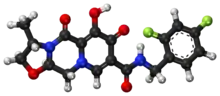
It is an integrase inhibitor with a carbamoyl pyridone structure similar to that of dolutegravir.[5]
Medical uses
Cabotegravir in combination with rilpivirine is indicated for the treatment of human immunodeficiency virus type-1 (HIV-1) in adults. The combination injection is intended for maintenance treatment of adults who have undetectable HIV levels in the blood (viral load less than 50 copies/mL) with their current antiretroviral treatment, and when the virus has not developed resistance to non-nucleoside reverse transcriptase inhibitors (NNRTIs) and integrase strand transfer inhibitors. The tablets are used to check whether a person tolerates the treatment before the injection therapy is started.[6][7]
The two medicines are the first antiretroviral drugs that come in a long-acting injectable formulation.[6] This means that instead of daily pills, people receive intramuscular injections monthly or every two months.[6]
Contraindications and interactions
Cabotegravir must not be combined with the drugs rifampicin, rifapentine, carbamazepine, oxcarbazepine, phenytoin or phenobarbital, which induce the enzyme UGT1A1. These drugs significantly decrease cabotegravir concentrations in the body and thus may reduce its effectiveness.[4] Additionally, they induce the enzyme CYP3A4, which leads to reduced rilpivirine concentrations in the body.[8]
Adverse effects
The most common side effects of the injectable combination therapy with rilpivirine are reactions at the injection site (in up to 84% of patients) such as pain and swelling, as well as headache (up to 12%) and fever or feeling hot (in 10%). For the tablets, headache and a hot feeling were slightly less frequent. Less common side effects (under 10%) for both formulations are depressive disorders, insomnia, and rashes.[4]
Pharmacology
Mechanism of action
Cabotegravir is an integrase strand transfer inhibitor. This means it blocks the HI virus's enzyme integrase, thereby preventing its genome from being integrated into the human cells' DNA. As this is a necessary step for the virus to replicate, its further spread is hampered.[4]
Pharmacokinetics

When taken by mouth, cabotegravir reaches highest blood plasma levels after three hours. Taking the drug together with food slightly increases its concentrations in the blood, but this is not clinically relevant. After injection into the muscle, cabotegravir is slowly absorbed into the bloodstream, reaching its highest blood plasma levels after about seven days.[4]
Over 99% of the substance are bound to plasma proteins. The drug is inactivated in the body by glucuronidation, mainly by the enzyme UGT1A1, and to a much lesser extent by UGT1A9. More than 90% of the circulating substance are the unchanged cabotegravir, however. The biological half-life is 41 hours for the tablets and 5.6 to 11.5 weeks for the injection.[4]
Elimination has only been studied for oral administration: Most of the drug is eliminated via the faeces in unchanged form (47%). It is not known how much of this amount comes from the bile, and how much was not absorbed in the first place. (The bile actually contains the glucuronide, but this could be broken up again in the gut lumen to give the parent substance that is observed in the faeces.) To a lesser extent it is excreted via the urine (27%), almost exclusively as the glucuronide.[4]
Pharmacogenomics
UGT1A1 poor metabolizers have 1.3- to 1.5-fold increased cabotegravir concentrations in the body. This is not considered clinically significant.[4]
Chemistry
Cabotegravir is a white to off-white, crystalline powder that is practically insoluble in aqueous solutions under pH 9, and slightly soluble above pH 10. It is slightly acidic with a pKa of 7.7 for the enolic acid and 1.1 (calculated) for the carboxamide. The molecule has two asymmetric carbon atoms; only one of the four possible configurations is present in the medication.[10]
Formulation
In studies, the agent was packaged into nanoparticles (GSK744LAP) conferring a biological half-life of 21 to 50 days following a single dose. The marketed injection achieves its long half-life not via nanoparticles but with a suspension of the free cabotegravir acid. The tablets contain cabotegravir sodium salt.[10]
History
Cabotegravir was examined in the clinical trials HPTN 083 and HPTN 084.[11][12] In 2020, the Committee for Medicinal Products for Human Use (CHMP) of the European Medicines Agency (EMA) adopted a positive opinion, recommending the granting of a marketing authorization for the medicinal product Vocabria intended for the treatment of human immunodeficiency virus type 1 (HIV-1) infection in combination with rilpivirine injection.[13] The EMA also recommended marketing authorization be given for rilpivirine and cabotegravir injections to be used together for the treatment of people with HIV-1 infection.[6]
Society and culture
Names
Cabotegravir is the United States Adopted Name (USAN)[14] and the international nonproprietary name (INN).[15]
Research
Pre-exposure prophylaxis
In 2020, results for some studies were released showing success in using injectable cabotegravir for long-acting pre-exposure prophylaxis (PrEP) with greater efficacy than the emtricitabine/tenofovir combination being widely used for PrEP at the time.[16][17]
References
- "Vocabria Product information". Health Canada. Retrieved 22 January 2021.
- "FDA Approves First Extended-Release, Injectable Drug Regimen for Adults Living with HIV". U.S. Food and Drug Administration (FDA) (Press release). 21 January 2021. Retrieved 21 January 2021.
 This article incorporates text from this source, which is in the public domain.
 - "Vocabria EPAR". European Medicines Agency (EMA). Retrieved 22 January 2021.
- "Vocabria: EPAR – Product information" (PDF). European Medicines Agency. 5 January 2021.
- Borrell, Brendan (2014). "Long-acting shot prevents infection with HIV analogue". Nature. doi:10.1038/nature.2014.14819. S2CID 184399045.
- "First long-acting injectable antiretroviral therapy for HIV recommended approval" (Press release). European Medicines Agency (EMA). 16 October 2020. Retrieved 16 October 2020.
- Vocabria FDA Professional Drug Information. Accessed 2021-02-24.
- Rilpivirine Monograph. Accessed 2021-02-23.
- Patel, Mitesh; Eberl, H. Christian; Wolf, Andrea; Pierre, Esaie; Polli, Joseph W.; Zamek-Gliszczynski, Maciej J. (2019). "Mechanistic Basis of Cabotegravir–Glucuronide Disposition in Humans". Journal of Pharmacology and Experimental Therapeutics. 370 (2): 269–277. doi:10.1124/jpet.119.258384. PMID 31175220. S2CID 182950312.
- "Vocabria: EPAR – Public assessment report" (PDF). European Medicines Agency. 5 January 2021.
- "HPTN083 — Prevention Now". HIV Prevention Trials Network. Retrieved 2 December 2017.
- "HPTN084 — Prevention Now". HIV Prevention Trials Network. Retrieved 2 December 2017.
- "Vocabria: Pending EC decision". European Medicines Agency (EMA). 16 October 2020. Retrieved 16 October 2020. Text was copied from this source which is © European Medicines Agency. Reproduction is authorized provided the source is acknowledged.
- "Adopted USANs" (PDF). American Medical Association. Retrieved 19 September 2014.
- World Health Organization (2015). "International nonproprietary names for pharmaceutical substances (INN): recommended INN: list 73". WHO Drug Information. 29 (1): 70–1. hdl:10665/331088.
- Ryan, Benjamin (7 July 2020). "Injectable PrEP Is Even More Effective Than Daily Truvada". Poz. Retrieved 9 November 2020.
- Ryan, Benjamin (9 November 2020). "For Women, Injectable Cabotegravir Is More Effective Than Truvada as PrEP". Poz. Retrieved 9 November 2020.
External links
- "Cabotegravir". Drug Information Portal. U.S. National Library of Medicine.