Statistics of the COVID-19 pandemic in Argentina
This article presents official statistics gathered during the COVID-19 pandemic in Argentina. The National Ministry of Health publishes official numbers every night.[1]
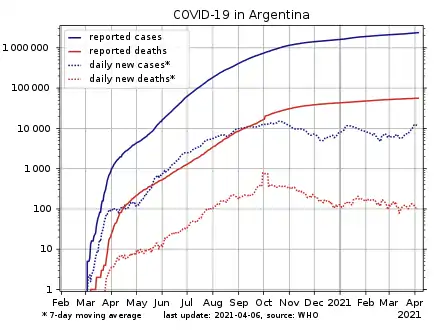
Since 12 March 2020, contrasted data between the numbers reported by the provincial ministries and the total number provided by the national Ministry of Health show differences. This is due to the fact that the ministries are giving their reports at different times throughout the day and also to different criteria regarding the counting of infected: by district of hospitalization or district of residence.[2]
On 27 September 2020, the Ministry of Health of the Province of Buenos Aires (the most populated one) reported more than 3,500 extra deaths that were missed in previous reports. The provincial government called this a "re-categorization", and presented a new data entry system which —according to Provincial Health Minister Daniel Gollán— would avoid future under-reporting and data criticism.[3][4] The deaths were later included in the national report of 1 October 2020.[5]
Model-based simulations for Argentina indicate that the 95% confidence interval for the time-varying reproduction number Rt exceeded 1.0 from April to July 2020, after which it diminished to below 1.0 in October and November 2020.[6]
By province
| Region | Cases[lower-alpha 1][lower-alpha 2] | Deaths[lower-alpha 1] | Recov.[lower-alpha 1][lower-alpha 2] | Cases/ 100k[lower-alpha 1][lower-alpha 3] |
Ref. | |
|---|---|---|---|---|---|---|
 |
Argentina | 2,383,483 | 56,106 | 2,130,586 | 5,941 | [8] |
 |
Buenos Aires (C)[lower-alpha 4] | 458,871 | 9,520 | 399,359 | 15,872 | [9] |
 |
Buenos Aires (P) | 1,004,976 | 28,335 | 777,211 | 6,432 | [10][11] |
 |
Catamarca | 11,727 | 74 | 9,050 | 3,188 | [12] |
 |
Chaco | 38,945 | 940 | 36,561 | 3,691 | [13] |
 |
Chubut | 54,556 | 904 | 52,950 | 10,716 | [14][15] |
 |
Córdoba | 183,076 | 3,045 | No data[lower-alpha 5] | 5,533 | [16][17] |
 |
Corrientes | 32,306 | 532 | 30,463 | 3,255 | [18][19] |
 |
Entre Ríos | 51,447 | 951 | No data[lower-alpha 6] | 4,162 | [20] |
 |
Formosa | 2,837 | 47 | 1,791 | 535 | [21] |
 |
Jujuy | 22,597 | 974 | 19,208 | 3,356 | [22] |
 |
La Pampa | 21,318 | 320 | 20,105 | 3,925 | [23] |
 |
La Rioja | 11,474 | 479 | 10,293 | 3,439 | [24][25] |
 |
Mendoza | 70,827 | 1,523 | 66,497 | 4,073 | [26] |
 |
Misiones | 12,713 | 235 | 11,350 | 1,154 | [27] |
 |
Neuquén | 66,434 | 1,221 | 62,465 | 12,051 | [28] |
 |
Río Negro | 56,627 | 1,327 | 54,217 | 8,867 | [29] |
 |
Salta | 29,253 | 1,182 | 25,782 | 2,409 | [30] |
 |
San Juan | 22,650 | 454 | 21,135 | 3,326 | [31] |
 |
San Luis | 27,689 | 424 | 25,642 | 6,405 | [32] |
 |
Santa Cruz | 40,977 | 643 | 38,667 | 14,957 | [33] |
 |
Santa Fe | 233,348 | 4,187 | 218,698 | 7,305 | [34] |
 |
Santiago del Estero | 25,251 | 285 | 20,640 | 2,889 | [35] |
 |
Tierra del Fuego[lower-alpha 2] | 23,771 | 377 | No data[lower-alpha 7] | 18,687 | [36] |
 |
Tucumán | 85,166 | 1,595 | 78,553 | 5,881 | [37] |
| Last updated: 04.04.2021, 13:00 (UTC-3) · History of cases: Argentina | ||||||
Notes
| ||||||
Maps
 Number of confirmed cases by province.
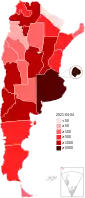 Number of confirmed COVID-19 deaths by province.
 Number of confirmed COVID-19 cases by jurisdiction.
 Number of confirmed COVID-19 cases by jurisdiction in Greater Buenos Aires.
Progression charts
Nationwide
The charts show the development of the pandemic starting from 3 March 2020, representing changes in net number of cases on a daily basis, based on the number of cases reported in the National Ministry of Health's daily reports.[1]
By district
The charts show the development of the pandemic starting from 3 March 2020, representing changes in net number of cases on a daily basis, based on the number of cases reported in the daily reports by each district.
Deaths
The charts show the development of deaths related to the pandemic starting from 7 March 2020, representing changes in net number of deaths on a daily basis, based on the number of deaths reported in the National Ministry of Health's daily reports.
Medical care
The charts show the development of ICU beds occupation related to the pandemic starting from 24 June 2020, representing changes in net number of beds occupation on a daily basis, based on the numbers reported in the National Ministry of Health's daily reports.
Vaccine distribution
The charts show the development of vaccination in Argentina starting from 6 January 2021, based on the National Ministry of Health's reports.[38]
Demographics
|
| ||||||||||||||||||||||||||||||||||||||||||||||||||||||||||||
See also
- COVID-19 pandemic by country
- COVID-19 pandemic in South America
- Timeline of the COVID-19 pandemic in Argentina
- 2020 in Argentina
- 2021 in Argentina
References
- "Informes diarios" [Daily reports] (in Spanish). Ministry of Health.
- "Coronavirus en Argentina: confirman 9 casos más y ya son 65 los contagiados". Clarín (in Spanish). 16 March 2020.
- "Death toll reaches 15,000 as Covid-19 surge continues". Buenos Aires Times. 26 September 2020. Retrieved 27 September 2020.
- Costa, José María (26 September 2020). "Coronavirus. Buenos Aires cambió el método de registro de muertos y sumó más de 3500: ahora son 12.566" [Coronavirus: Buenos Aires changed the way it registers the death toll and added over 3500 deaths: they are now 12,566]. La Nación (in Spanish). ISSN 0325-0946. Retrieved 27 September 2020.
- Costa, José María (1 October 2020). "Coronavirus: Buenos Aires cargó casi 3200 muertos y la Argentina superó los 20.000 fallecidos" [Coronavirus: Buenos Aires uploaded almost 3,200 deaths and Argentina exceeded 20,000 deaths]. La Nación (in Spanish). Retrieved 2 October 2020.
- "Situation Report for COVID-19: Argentina". MRC Centre for Global Infectious Disease Analysis, Imperial College London.
- "Población por sexo e índice de masculinidad. Superficie censada y densidad, según provincia. Total del país. Año 2010". Censo Nacional de Población, Hogares y Viviendas 2010 (in Spanish). National Institute of Statistics and Census of Argentina (INDEC). 2010. Archived from the original on 8 June 2014.
- "Informes diarios" [Daily reports] (in Spanish). Government of Argentina.
- "Actualización de los casos de coronavirus en la Ciudad" (in Spanish). Government of the City of Buenos Aires.
- "EMERGENCIA SANITARIA" (in Spanish). Government of the Province of Buenos Aires.
- "Sala de Situación del Ministerio de Salud COVID-19" (in Spanish). Government of the Province of Buenos Aires.
- "Portal de Gobierno de Catamarca" (in Spanish). Government of the Province of Catamarca.
- "Servicio Informativo Oficial de Chaco" (in Spanish). Government of the Province of Chaco.
- "Gobierno del Chubut — Portal" (in Spanish). Ministry of Health of Chubut.
- "COVID-19 ACTUALIZACIONES EPIDEMIOLÓGICAS" (in Spanish). Ministry of Health of Chubut.
- "Informe diario de casos y medidas - Gobierno de Córdoba" (in Spanish). Government of the Province of Córdoba.
- "Web de Noticias - Gobierno de Córdoba" (in Spanish). Government of the Province of Córdoba.
- "Portal del Gobierno de Corrientes" (in Spanish). Government of the Province of Corrientes.
- "Gobierno de Corrientes". Twitter (in Spanish). Government of the Province of Corrientes.
- "Parte Epidemiológico - Secretaría de Comunicación de la Provincia de Entre Ríos" (in Spanish). Government of the Province of Entre Ríos.
- "Partes Diarios" (in Spanish). Government of the Province of Formosa.
- "Dirección Provincial de Prensa" (in Spanish). Government of the Province of Jujuy.
- "APN La Pampa" (in Spanish). Government of the Province of La Pampa.
- "Ministerio de Salud Pública — La Rioja" (in Spanish). Ministry of Public Health of La Rioja.
- "Ministerio de Salud de La Rioja". Twitter (in Spanish). Ministry of Public Health of La Rioja.
- "Salud : Prensa Gobierno de Mendoza" (in Spanish). Government of the Province of Mendoza.
- "Ministerio de Salud Pública — Misiones" (in Spanish). Government of the Province of Misiones.
- "Noticias Del Ministerio De Salud" (in Spanish). Ministry of Health of Neuquén.
- "Portal de Noticias — Gobierno de Río Negro" (in Spanish). Government of the Province of Río Negro.
- "Histórico de Noticias del Gobierno de Salta" (in Spanish). Government of the Province of Salta.
- "Salud Pública" (in Spanish). Government of the Province of San Juan.
- "Coronavirus — Gobierno San Luis" (in Spanish). Government of the Province of San Luis.
- "Santa Cruz - Noticias Destacadas" (in Spanish). Government of the Province of Santa Cruz.
- "CORONAVIRUS (Covid 19)" (in Spanish). Government of the Province of Santa Fe.
- "Ministerio de Salud - Santiago del Estero" (in Spanish). Ministry of Health of Santiago del Estero.
- "coronavirus — Gobierno de Tierra del Fuego" (in Spanish). Government of the Province of Tierra del Fuego.
- "Noticias Destacadas — Ministerio de Salud Pública de Tucumán" (in Spanish). Government of the Province of Tucumán.
- "Monitor Público de Vacunación" [Public Vaccination Monitor] (in Spanish). Ministry of Health.
- "Información epidemiológica" [Epidemiological Information] (in Spanish). Ministry of Health. Retrieved 2 February 2021.
External links
- COVID-19 Global Cases and historical data by Johns Hopkins University.
- COVID-19 Cases in Argentina
| |||||||||||||||||||
| |||||||||||||||||||
| |||||||||||||||||||
| |||||||||||||||||||
| |||||||||||||||||||
| |||||||||||||||||||
| |||||||||||||||||||

